How Can QCA Address the Need for Higher Circuit Density and Faster Computing?

  • Home
  • How Can QCA Address the Need for Higher Circuit Density and Faster Computing?
Quantum-dot Cellular Automata (QCA): A New Paradigm for Digital Circuit Design | Scintillation Research
Patent Intelligence Report  ·  Beyond-CMOS Computing Series

Quantum-dot Cellular Automata (QCA): A New Paradigm for Digital Circuit Design

A data-grounded look at who is filing, where innovation is concentrated, and why QCA is emerging as a credible transistor-less path beyond the physical limits of CMOS scaling.

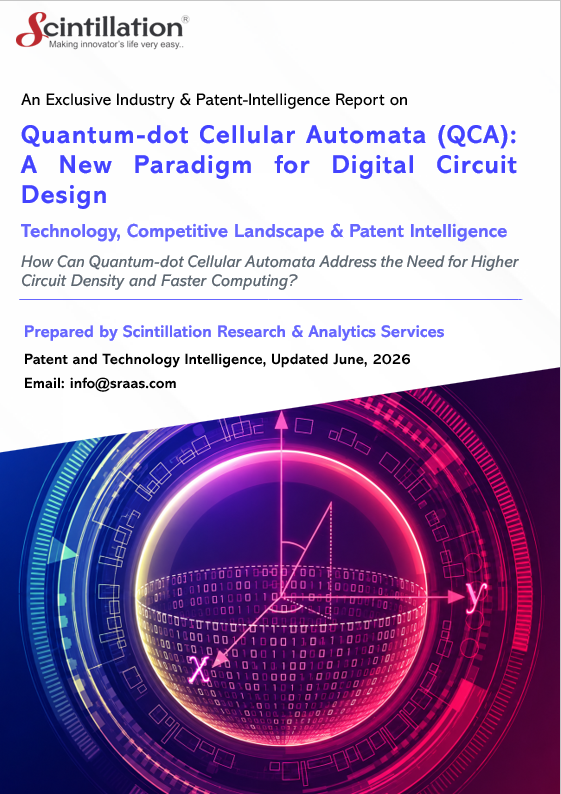
A comprehensive technology and patent intelligence analysis of Quantum-dot Cellular Automata — examining cell polarization states, clocking mechanisms, molecular and magnetic QCA architectures, fault-tolerant circuit design, memory structures, and arithmetic circuit implementations enabling a transistor-less, nanoscale alternative to traditional CMOS computing.

Transistor-lessElectron-position computing
Cell PolarizationBinary state representation
Beyond CMOSPost-transistor scaling path
PatentLandscape & whitespace analysis

Report details

Quantum-dot Cellular Automata (QCA) — Technology & Patent Intelligence Report

Publisher Scintillation Research
Technology Quantum-dot Cellular Automata
Focus area Beyond-CMOS Nanocomputing
Key segments Molecular QCA, Magnetic QCA, Clocking
IP coverage Patent landscape study
Applications Nanoelectronics, Memory, Arithmetic Circuits
Audience IP, R&D, Strategy, Investment
QCA Quantum-dot cellular automata
e⁻ Electron-position information
0V Current-flow-free switching
IP Patent landscape study
nm Nanoscale device density
Introduction

When CMOS scaling can no longer meet the density, power, and heat demands of next-generation computing

The semiconductor industry is entering a new era of computing driven by exponential growth in quantum dot technologies across multiple domains. Next-generation workloads require computing platforms that deliver an extremely high level of processing performance with high energy efficiency, less heat generation, and a lower physical footprint, simultaneously. Traditional Complementary Metal-Oxide-Semiconductor (CMOS) technology is straining under the pressures of power density, leakage current, interconnect delays, complexity, and rising fabrication costs as atomic-scale dimensions come into range.

Over the last few decades, transistor scaling has provided the primary means by which the semiconductor industry has improved computational performance and energy efficiency. But going beyond advanced technology nodes has become more difficult due to quantum-mechanical effects, variability, and economic limitations in next-generation fabrication processes. As a result, researchers, semiconductor manufacturers, and academic institutions are actively exploring alternative computing paradigms that extend computational capabilities beyond the limitations of conventional CMOS architectures.

Among the various beyond-CMOS technologies under investigation, Quantum-dot Cellular Automata (QCA) has emerged as a promising nanoscale computing approach. Unlike traditional transistor-based circuits that rely on current flow for information processing, QCA uses the arrangement and interactions of electrons within quantum dots to represent and manipulate binary information via cell polarisation states. This fundamentally different operating principle enables ultra-low power computation, high device density, reduced switching energy, and potentially faster information propagation compared to conventional transistor-based technologies.

The growing demand for energy-efficient computing has positioned QCA as a potential candidate for future nanoelectronics systems, particularly in applications where power efficiency, circuit density, and computational speed are critical requirements. Research activities worldwide are focused on developing practical QCA architectures, clocking mechanisms, fault-tolerant designs, memory structures, arithmetic circuits, and system-level implementations to support next-generation computing platforms. Recent advances in molecular QCA, magnetic QCA, and fabrication methodologies have further strengthened interest in the technology as a long-term solution for overcoming the limitations of CMOS scaling.

As part of broader efforts to develop sustainable, energy-efficient computing technologies, industry stakeholders, research organizations, and government-funded semiconductor initiatives have become increasingly interested in QCA. While significant challenges remain regarding fabrication precision, operating temperature requirements, defect tolerance, large-scale integration, and commercialization readiness, QCA continues to attract substantial research investment due to its theoretical advantages in computational efficiency and nanoscale device integration.

Report structure

Table of contents

Ten chapters connecting QCA's technical foundations to patent landscape intelligence and commercialization strategy. Click any chapter to expand.

Condensed findings on QCA technology, patent filing trends, assignee dynamics, and strategic implications for beyond-CMOS nanocomputing IP
2.1 Who Will Benefit from This Report — nanoelectronics researchers, semiconductor strategists, IP counsel, academic institutions, and technology investors tracking beyond-CMOS computing paradigms
3.1 Challenges in Transistorless Nano-Computing QCA Technology — manufacturing precision, thermal stability, interconnect routing, and defect tolerance limitations facing practical QCA implementation
Structural foundations — quantum dot cell arrangements, electron tunneling junctions, cell polarization states, and clocking-zone architectures
4.1 Key Features — ultra-low power computation, high device density, reduced switching energy, and current-flow-free information propagation
4.2 Problems QCA Aims to Solve — CMOS power dissipation, heat generation, physical scaling limits, and interconnect delay constraints
4.3 Potential Applications — nanoelectronics devices, memory structures, arithmetic circuits, and next-generation low-power computing systems
QCA commercialization roadmap, fabrication readiness, molecular and magnetic QCA progress, and near-term pathways toward practical nanoelectronics deployment
6.1 Methodology & Scope — patent database coverage, search strategy, classification framework, and analytical approach for QCA IP
6.2 Who Is Filing — leading filers across semiconductor manufacturers, academic institutions, and government-funded research initiatives shaping the QCA IP landscape
6.3 Filing Activity Over Time — trend analysis identifying R&D acceleration and IP maturity signals across QCA technology domains
6.4 Jurisdiction Coverage — USPTO, CNIPA, KIPO, JPO, EPO, and WIPO distributions across the QCA patent landscape
6.5 Technology Segmentation — patents mapped to molecular QCA, magnetic QCA, clocking mechanisms, fault-tolerant design, memory structures, and arithmetic circuits
6.6 Whitespace & Strategic Opportunities — underprotected technology domains and emerging filing opportunities across the QCA IP ecosystem
Stakeholder-specific takeaways for nanoelectronics researchers, semiconductor strategists, IP counsel, and technology investors
Synthesis of QCA's technical trajectory, IP landscape dynamics, and strategic implications for next-generation semiconductor and nanoelectronics commercialization
Publisher profile, research methodology, and service overview — patent analytics, technology scouting, competitive intelligence, and strategic research across nanoelectronics domains
Full legal disclaimer covering information accuracy, IP ownership, and terms of use for this intelligence report
Inside Quantum-dot Cellular Automata

Structural foundations & key features

QCA replaces current-flow transistor switching with the position of electrons within quantum dot cells — representing binary information through cell polarization states and propagating it through carefully sequenced clocking zones, entirely without conventional current-driven logic.

Quantum dot cell arrays
Grids of coupled quantum dots, each cell holding a pair of mobile electrons whose relative position encodes a binary state — the fundamental building block of QCA logic.
Cell polarization states
Binary "0" and "1" values represented by the diagonal position of electrons within a cell — switching state through electrostatic repulsion rather than current flow.
Clocking mechanisms
Multi-phase clocking-zone architectures that sequence the propagation of polarization states across the cell array, enabling controlled, directional signal flow.
Molecular QCA
QCA implementations using individual molecules as quantum dot cells — offering a path to room-temperature operation and extreme device density beyond metal-dot approaches.
Magnetic QCA (MQCA)
QCA implementations using nanomagnet polarization rather than electron position — offering non-volatility and an alternative path to practical fabrication.
Fault-tolerant circuit design
Redundancy and error-correction architectures addressing the sensitivity of QCA cells to fabrication defects and stray polarization — critical for reliable large-scale circuits.
Memory & arithmetic circuit structures
QCA implementations of logic gates, adders, multiplexers, and memory cells — establishing the building blocks needed for complete digital circuit functionality.
System-level integration architectures
Approaches for combining individual QCA logic elements into complete functional systems, addressing interconnect routing and signal-timing challenges at scale.
Challenges addressed

Why CMOS scaling cannot meet next-generation density and efficiency demands

QCA directly targets the physical scaling, power, and heat constraints that limit how far conventional CMOS can continue to scale — while introducing new technical hurdles of its own around fabrication precision and thermal stability that the field is actively working to resolve.
01
Power dissipation & leakage current
CMOS transistors leak current even when nominally switched off, and power dissipation grows substantially as devices are packed more densely. QCA's electron-position switching eliminates current flow as the basis for computation, fundamentally reducing power dissipation
Power dissipation
02
Heat generation at scale
Rising power density in advanced CMOS nodes generates heat that constrains achievable clock speeds and device packing density. QCA's ultra-low switching energy offers a path to substantially reduced heat generation at comparable or higher device density
Heat generation
03
Physical scaling limits
Transistor scaling is increasingly constrained by quantum-mechanical effects, fabrication variability, and economic limits at advanced nodes. QCA's nanoscale, transistor-less architecture offers a fundamentally different scaling pathway not bound by the same lithographic limits
Scaling limits
04
Manufacturing precision & defect tolerance
Reliable QCA operation depends on extremely precise placement and spacing of quantum dots or molecules, and the technology remains sensitive to fabrication defects and stray charge. Fault-tolerant circuit design and improved fabrication methodologies are active areas of ongoing research
Manufacturing precision
05
Thermal stability & interconnect routing
Many QCA implementations require very low operating temperatures to maintain stable cell polarization, and routing signals between clocking zones at scale introduces design complexity not present in conventional CMOS layouts. Molecular QCA and improved clocking architectures are being explored to address these constraints
Thermal stability

Download Your Sample Report Now:

    Application areas

    Where QCA creates emerging computational impact

    QCA's density, power, and switching-speed advantages are most compelling in applications where conventional CMOS approaches face fundamental scaling, energy, or heat-dissipation limits.

    Nanoelectronics Devices
    Ultra-dense, low-power electronic devices leveraging QCA's nanoscale footprint and reduced switching energy
    Memory Architectures
    High-density, low-power memory structures built from QCA cell arrays, offering an alternative to conventional transistor-based memory
    Arithmetic & Logic Circuits
    Adders, multiplexers, and logic gate implementations forming the computational building blocks of QCA-based digital systems
    Energy-Efficient Computing Platforms
    Next-generation computing systems prioritizing energy efficiency, low heat output, and reduced physical footprint
    Molecular Electronics
    Molecular QCA implementations contributing to the broader field of molecular-scale electronic device research
    Magnetic Logic Systems
    Magnetic QCA architectures offering non-volatile logic and memory applications distinct from charge-based implementations
    Academic & Government Research Programs
    Government-funded semiconductor initiatives and academic institutions advancing fundamental QCA research and fabrication methodology
    Next-Generation Semiconductor Manufacturing
    Broader beyond-CMOS manufacturing innovation drawing on QCA fabrication and integration techniques
    Patent intelligence

    The QCA patent landscape

    The patent landscape chapter delivers data-grounded IP intelligence — from methodology and filer profiling to filing trends, jurisdiction coverage, technology segmentation, and whitespace identification across the full QCA ecosystem.

    Filing & jurisdiction intelligence
    • Methodology and scope defining the boundaries of QCA patent analysis
    • Who is filing — semiconductor manufacturers, academic institutions, and government-funded research initiatives shaping the QCA IP landscape
    • Filing activity over time — trend analysis identifying R&D acceleration points and IP maturity signals across the technology domain
    • Jurisdiction coverage — USPTO, CNIPA, KIPO, JPO, EPO, and WIPO distributions across the QCA patent corpus
    Technology & strategic analysis
    • Technology segmentation — molecular QCA, magnetic QCA, clocking mechanisms, fault-tolerant design, memory structures, and arithmetic circuits
    • Whitespace & strategic opportunities — underprotected technology domains and emerging QCA filing and licensing opportunities
    • Strategic implications for freedom-to-operate, partnership, and research-collaboration decisions across the QCA ecosystem
    • Signals of competitive intensity and IP maturity heading into anticipated fabrication and commercialization milestones
    Who will benefit

    Who should read this report

    Nanoelectronics & Device Physics Researchers
    Researchers designing quantum dot cell architectures, clocking mechanisms, and molecular or magnetic QCA implementations for next-generation nanocomputing.
    Semiconductor Strategists & Manufacturers
    Technology strategists evaluating QCA as a beyond-CMOS computing pathway and assessing fabrication readiness against conventional transistor scaling roadmaps.
    IP Counsel & Patent Teams
    Attorneys and patent professionals assessing portfolio positioning, whitespace, freedom-to-operate, and filing strategy across QCA cell, clocking, and circuit-design technologies.
    Academic & Government Research Institutions
    Research organizations and government-funded semiconductor initiatives tracking QCA research direction and identifying collaboration and funding opportunities.
    Technology Investors
    Investment professionals tracking the beyond-CMOS computing ecosystem, the QCA IP landscape, and emerging companies in nanoscale and molecular electronics.
    R&D Strategists & Industry Analysts
    Researchers and consultants mapping the competitive QCA landscape across semiconductor manufacturers, academic institutions, and research initiatives driving adoption.
    Technology & Patent Intelligence · Scintillation Research

    Understand who is building the IP foundation for transistor-less nanocomputing

    Get the complete technology and patent intelligence report on Quantum-dot Cellular Automata — from cell polarization and clocking architectures to the patent landscape revealing who is filing, where innovation is concentrated, and why QCA is emerging as a credible path beyond the physical limits of CMOS scaling.

    Scintillation Research · Quantum-dot Cellular Automata (QCA) · Patent Intelligence Series

    For a quick demo, schedule a meeting now!

    Service Demo Booking
    About

    About Scintillation Research

    Scintillation Research & Analytics Services is a specialized intellectual property and technology intelligence firm delivering patent analytics, technology scouting, competitive intelligence, and strategic research services.

    Through comprehensive patent and technology intelligence reports, we help organizations understand emerging innovations, identify market opportunities, monitor competitors, and make data-driven decisions across rapidly evolving technology domains. Our reports are designed for professionals at the intersection of technology strategy, IP management, and competitive intelligence.

    Shopping Cart (0 items)

    Subscribe to our newsletter

    Sign up to receive latest news, updates, promotions, and special offers delivered directly to your inbox.
    No, thanks
    Select your currency