How Quantum AI Aims to Transform Intelligent Computing

  • Home
  • How Quantum AI Aims to Transform Intelligent Computing
Quantum AI: How It Aims to Transform Intelligent Computing | Scintillation Research
Patent Intelligence Report  ·  Quantum Technologies Series

How Quantum AI Aims to Transform
Intelligent Computing

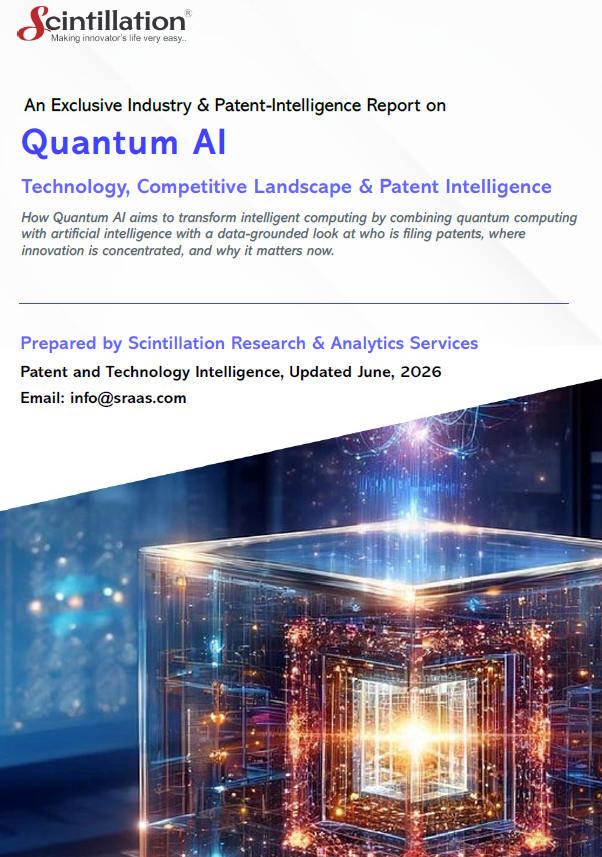
Combining quantum computing with artificial intelligence — a data-grounded look at who is filing patents, where innovation is concentrated, and why it matters now.

A comprehensive technology and patent intelligence analysis of Quantum AI — examining quantum-enhanced machine learning, quantum neural networks, hybrid quantum-classical architectures, and the evolving IP landscape across networking, communications, drug discovery, financial services, and next-generation intelligent systems.

Quantum MLEnhanced learning algorithms
6G / 5GNetwork AI optimization
HybridQuantum-classical systems
9-partPatent landscape analysis

Report details

Quantum AI — Technology & Patent Intelligence Report

Publisher Scintillation Research
Technology Quantum AI
Core convergence Quantum computing + AI
Focus domains Networking, 5G/6G, IoT, edge, QKD
IP coverage 9-part patent landscape
Chapters 10 structured chapters
Audience IP, R&D, Telecom, Investment
Quantum + AI convergence
5G / 6G Network optimization
Hybrid Classical-quantum systems
IP 9-part patent analysis
360° Ecosystem coverage
Introduction

Two transformative technologies converging into one

Quantum AI represents the convergence of quantum computing and artificial intelligence — with the potential to redefine the future of computing and intelligent decision-making across industries.

While AI enables machines to learn from data, recognize patterns, and automate complex tasks, quantum computing introduces a fundamentally new approach to computation by utilizing quantum mechanical principles such as superposition and entanglement. Together, these technologies offer the possibility of solving computational problems that are beyond the practical capabilities of traditional computing systems.

The rapid growth of AI applications has led to increasing demands for computational power, data processing capabilities, and energy resources. Quantum AI seeks to address these challenges by leveraging quantum computing to accelerate machine learning, optimization, simulation, and data analysis processes. A key area of research is the development of quantum-enhanced machine learning algorithms and quantum neural networks — aiming to utilize parallel processing capabilities to improve pattern recognition, predictive analytics, optimization, and decision-making.

Although Quantum AI remains at an early stage of technological maturity, substantial investments from industry leaders, research institutions, and governments worldwide are accelerating innovation. Advances in quantum hardware, quantum algorithms, and hybrid quantum-classical computing architectures continue to expand the range of commercial opportunities — while challenges related to scalability, error correction, and integration with existing digital infrastructures remain active areas of research.

Report structure

Table of contents

Ten chapters connecting Quantum AI's scientific foundations to patent landscape intelligence, networking applications, and commercialization strategy. Click any chapter to expand.

Condensed findings on Quantum AI technology, key patent assignees, filing trends, and strategic implications for intelligent computing and quantum networking
2.1 Who Will Benefit from This Report — quantum researchers, AI engineers, telecom strategists, IP counsel, policymakers, network operators, and technology investors
3.1 Challenges in Classical AI — computational power limits, energy inefficiency, optimization bottlenecks, latency constraints, scalability barriers, and security vulnerabilities in large-scale AI systems
4.1 Key Features — quantum-enhanced machine learning, quantum neural networks, variational quantum algorithms, superposition-based parallel processing, and hybrid quantum-classical architectures
4.2 Problems Addressed — computational complexity, optimization at scale, network resource management, latency reduction, autonomous network management, and quantum-secure communications
4.3 Potential Applications — 5G/6G optimization, IoT intelligence, edge computing, drug discovery, financial modeling, logistics, cybersecurity, and distributed quantum computing
Technology readiness, near-term hybrid deployment opportunities, quantum hardware maturity, government investment programs, and long-term commercialization outlook across industries
6.1 Methodology & Scope — patent database coverage, search strategy, classification framework, and analytical approach for Quantum AI IP
6.2 Top Assignees with notable assignee profiles — leading filers across tech companies, telecom operators, national labs, quantum hardware firms, and research institutions
6.3 Filing Activity Over Time — trend analysis identifying R&D acceleration and IP maturity signals in Quantum AI technology domains
6.4 Jurisdiction Coverage — USPTO, CNIPA, EPO, KIPO, JPO, WIPO, and regional patent office distributions across the Quantum AI landscape
6.5 Legal Status Snapshot — granted, pending, expired, and lapsed portfolio breakdown by technology domain and assignee
6.6 Technology Segmentation — quantum ML algorithms, quantum neural networks, hybrid architectures, quantum optimization, network intelligence, and quantum-secure communication
6.7 Foundational Anchor Patents — core IP defining the Quantum AI landscape and their strategic competitive significance
6.8 Representative Publications Across the Field — key academic and industry publications shaping Quantum AI research direction and application development
6.9 Whitespace & Strategic Opportunities — unprotected technology domains and emerging filing opportunities across the Quantum AI IP ecosystem
Stakeholder-specific takeaways for quantum engineers, AI researchers, telecom operators, IP counsel, policymakers, investors, and network infrastructure strategists
Synthesis of Quantum AI's technical trajectory, IP landscape dynamics, and strategic implications for the future of intelligent computing and quantum networking
Publisher profile, research methodology, and service overview — patent analytics, technology scouting, competitive intelligence, and strategic research
Full legal disclaimer covering information accuracy, IP ownership, and terms of use for this intelligence report
Inside Quantum AI

Key features & technical capabilities

Quantum AI combines the parallel processing power of quantum computing with the pattern recognition and optimization capabilities of AI — enabling a new class of computational approaches that are physically impossible on classical systems alone.

Quantum-enhanced machine learning
Quantum algorithms for classification, regression, clustering, and generative modeling that exploit superposition and interference to achieve exponential speedups over classical ML counterparts.
Quantum neural networks (QNN)
Parameterized quantum circuits acting as trainable neural network architectures — potentially offering higher expressibility per parameter than classical deep neural networks for certain problem classes.
Hybrid quantum-classical architectures
Variational Quantum Eigensolver (VQE), QAOA, and other hybrid frameworks that leverage near-term quantum hardware for computationally intensive subroutines while classical systems handle control and optimization.
Quantum optimization
Quantum annealing and gate-based optimization algorithms for combinatorial problems in network routing, resource scheduling, supply chain logistics, and financial portfolio optimization.
Network resource AI optimization
Quantum-AI algorithms for real-time spectrum allocation, traffic routing, interference management, and autonomous network management in 5G, 6G, and dense IoT environments.
Quantum-secure AI communication
Integration of quantum key distribution with AI-driven network orchestration — enabling information-theoretically secure communication infrastructure with adaptive intelligent routing capabilities.
Quantum simulation for AI training
Quantum simulation of molecular, material, and physical systems to generate high-fidelity training data for AI models in drug discovery, materials science, and climate modeling.
Edge quantum-AI intelligence
Near-term quantum-classical hybrid systems deployed at network edge nodes — enabling local AI inference acceleration and latency reduction for time-critical IoT and autonomous systems applications.
Challenges addressed

Where classical AI reaches its limits

Quantum AI directly targets five structural constraints that prevent classical AI systems from meeting the computational demands of next-generation networking, communications, and large-scale data-intensive applications.
01
Computational complexity barriers
Many critical AI tasks — combinatorial optimization, simulation of quantum systems, high-dimensional data analysis — scale exponentially with problem size on classical hardware. Quantum AI algorithms offer polynomial or exponential speedups for specific problem classes that matter most to networking and communications
Complexity
02
Network scalability & resource optimization
5G and emerging 6G networks involve real-time optimization across millions of concurrent variables. Classical AI approaches face latency and convergence constraints. Quantum optimization algorithms can explore larger solution spaces simultaneously — enabling superior real-time network resource management
Optimization
03
AI security vulnerabilities
Quantum computers will eventually break RSA and ECC encryption protecting classical AI data pipelines. Quantum-secure AI communication using QKD provides information-theoretically secure channels that are immune to both classical and quantum adversarial attacks
Security
04
Energy inefficiency of large AI models
Training frontier AI models requires enormous energy — GPT-4 class training runs consume megawatt-hours. Quantum ML approaches may achieve equivalent or superior model performance with fundamentally lower parameter counts, reducing training energy requirements for specific problem domains
Efficiency
05
Latency in autonomous network management
Classical AI network orchestration cannot meet the sub-millisecond decision requirements of future autonomous 6G and IoT infrastructure. Quantum-AI hybrid systems offer faster convergence for real-time network routing, load balancing, and interference management decisions at ultra-low latency
Latency

Download Your Sample Report Now:

    Potential applications

    Where Quantum AI creates transformative value

    Quantum AI's combination of quantum speedup and AI intelligence unlocks breakthroughs across sectors where classical computation has reached fundamental limits.

    Networking & Communications
    5G / 6G network intelligence
    Quantum-AI for real-time spectrum allocation, interference management, beam optimization, traffic routing, and autonomous network self-management in dense 5G and next-generation 6G deployments.
    Healthcare & Life Sciences
    Drug discovery & molecular simulation
    Quantum simulation of molecular interactions combined with AI-driven drug candidate screening — dramatically accelerating the identification and optimization of pharmaceutical compounds.
    Financial Services
    Portfolio optimization & risk modeling
    Quantum optimization algorithms for financial portfolio construction, derivatives pricing, risk scenario simulation, and real-time fraud detection at scales impractical for classical systems.
    Cybersecurity
    Quantum-secure AI infrastructure
    Post-quantum cryptography integrated with AI-driven threat detection — securing AI data pipelines, model weights, and inference infrastructure against quantum adversarial attacks.
    IoT & Edge Computing
    Distributed quantum-AI inference
    Hybrid quantum-classical AI systems at edge nodes for ultra-low-latency intelligent processing in industrial IoT, autonomous vehicles, smart cities, and critical infrastructure management.
    Logistics & Supply Chain
    Combinatorial optimization at scale
    Quantum annealing and QAOA algorithms for large-scale route optimization, warehouse automation, supply chain scheduling, and last-mile delivery network design beyond classical solver capacity.
    Industry verticals

    Cross-industry impact of Quantum AI

    The report examines Quantum AI deployment opportunities and IP implications across a broad range of industry sectors where quantum-enhanced intelligence creates strategic advantage.

    Telecommunications & Networking
    5G/6G optimization, spectrum management, autonomous network operations
    Quantum Computing Platforms
    Hardware vendors, quantum cloud services, hybrid algorithm providers
    Healthcare & Pharma
    Drug discovery, genomics, clinical trial optimization, medical imaging AI
    Financial Services
    Portfolio optimization, risk modeling, algorithmic trading, fraud detection
    Cybersecurity
    Post-quantum cryptography, quantum-secure AI, threat intelligence
    Materials Science & Energy
    Battery design, catalyst discovery, quantum chemistry simulation for clean energy
    Defense & National Security
    Quantum-secure communications, AI-driven intelligence analysis, autonomous systems
    Logistics & Supply Chain
    Large-scale combinatorial optimization, route planning, warehouse AI
    Patent intelligence

    The Quantum AI patent landscape — a 9-part analysis

    The patent landscape chapter delivers data-grounded IP intelligence across the Quantum AI ecosystem — from top assignee profiling and filing trends to legal status, technology segmentation, anchor patents, and whitespace identification.

    Assignee & filing intelligence
    • Methodology and scope defining the patent search universe for Quantum AI and quantum-enhanced networking
    • Top assignees with notable profiles — tech companies, telecom operators, quantum hardware firms, national labs, and research institutions
    • Filing activity over time — trend analysis identifying R&D acceleration and IP maturity signals
    • Jurisdiction coverage — USPTO, CNIPA, EPO, KIPO, JPO, WIPO, and regional patent office distributions
    Technology & strategic analysis
    • Legal status snapshot — granted, pending, expired, and lapsed portfolio breakdown by domain
    • Technology segmentation — quantum ML, QNN, hybrid architectures, quantum optimization, network AI, quantum-secure comms
    • Foundational anchor patents and representative publications shaping Quantum AI research direction
    • Whitespace & strategic opportunities — unprotected technology domains and emerging filing opportunities
    Who will benefit

    Who should read this report

    Quantum & AI Researchers
    Scientists and engineers working on quantum ML algorithms, quantum neural networks, variational circuits, and hybrid quantum-classical systems for real-world AI applications.
    IP Counsel & Patent Teams
    Attorneys and patent professionals assessing Quantum AI portfolio positioning, whitespace, freedom-to-operate, and filing strategy across quantum computing and AI convergence domains.
    Telecom & Network Operators
    Telecommunications companies and network infrastructure providers evaluating Quantum AI for 5G/6G optimization, spectrum intelligence, autonomous network management, and quantum-secure communications.
    Technology Investors
    Investment professionals tracking the Quantum AI ecosystem, competitive IP landscape, and emerging companies across quantum hardware, quantum software, and AI-quantum integration platforms.
    Policymakers & Government
    Government agencies and national security professionals assessing Quantum AI's strategic implications for national quantum programs, technology competitiveness, and quantum-secure infrastructure.
    R&D Strategists & Industry Analysts
    Researchers and consultants mapping the competitive Quantum AI landscape across technology companies, research institutions, quantum hardware vendors, and telecommunications innovators.
    Technology & Patent Intelligence · Scintillation Research

    Understand the IP landscape shaping intelligent quantum computing

    Get the complete technology and patent intelligence report on Quantum AI — from quantum-enhanced machine learning and hybrid architectures to the patent landscape defining who is filing, where innovation is concentrated, and why it matters now.

    Scintillation Research · Quantum AI · Patent Intelligence Series

    For a quick demo, schedule a meeting now!

    Service Demo Booking
    About

    About Scintillation Research

    Scintillation Research & Analytics Services is a specialized intellectual property and technology intelligence firm delivering patent analytics, technology scouting, competitive intelligence, and strategic research services.

    Through comprehensive patent and technology intelligence reports, we help organizations understand emerging innovations, identify market opportunities, monitor competitors, and make data-driven decisions across rapidly evolving technology domains. Our reports are designed for professionals at the intersection of technology strategy, IP management, and competitive intelligence.

    Shopping Cart (0 items)

    Subscribe to our newsletter

    Sign up to receive latest news, updates, promotions, and special offers delivered directly to your inbox.
    No, thanks
    Select your currency