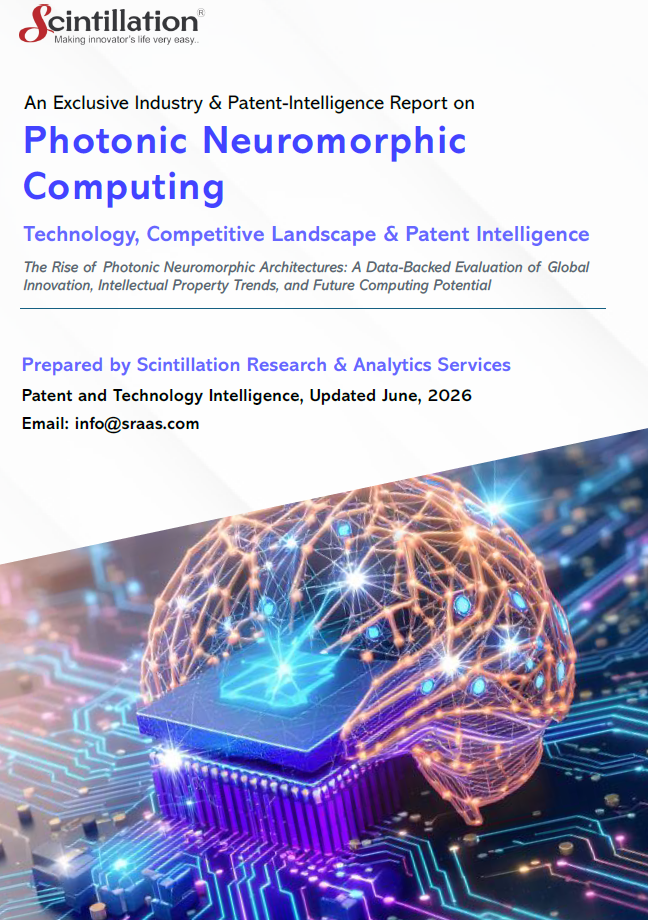
Photonic Neuromorphic Computing – Technology & Patent Intelligence Report

  • Home
  • Photonic Neuromorphic Computing – Technology & Patent Intelligence Report
Patent Intelligence Report  ·  Next-Generation Computing Series

Photonic Neuromorphic Computing — Processing at the Speed of Light with a Brain-Inspired Architecture

A data-grounded look at who is filing, where innovation is concentrated, and why it matters now.

A comprehensive technology and patent intelligence analysis of photonic neuromorphic computing — examining photonic neural networks, photonic integrated circuits, optical synapses, reservoir computing, silicon-photonics platforms, and the evolving IP landscape across AI, HPC, data centers, telecommunications, and edge computing.

Light-speedData processing
Brain-inspiredNeuromorphic architecture
Energy-efficientAI computation
8-partPatent landscape analysis

Report details

Photonic Neuromorphic Computing — Technology & Patent Intelligence Report

Publisher Scintillation Research
Technology Photonic Neuromorphic Computing
Core technologies Photonic NN, PIC, optical synapses, reservoir computing
Platform Silicon photonics, hybrid electronic-photonic
IP coverage 8-part patent landscape
Applications AI, HPC, data centers, telecom, edge
Audience IP, R&D, Strategy, Investment
Light Speed of processing
Neuro Brain-inspired design
PIC Photonic integrated circuits
IP 8-part patent analysis
360° Ecosystem coverage
Introduction

When electrons reach their limits, photons take over

The global computing industry is advancing rapidly as demand grows for more powerful artificial intelligence systems, high-performance computing platforms, data-center infrastructure, and edge-computing devices.

As AI workloads continue to increase in scale and complexity, conventional electronic computing architectures face growing challenges related to power consumption, memory bottlenecks, data-transfer limitations, and computational efficiency. The von Neumann bottleneck — the fundamental constraint imposed by separating memory from processing — becomes increasingly prohibitive as AI model sizes and inference demands scale exponentially.

Photonic Neuromorphic Computing addresses these constraints by combining the high-speed and parallel-processing capabilities of photonic systems with brain-inspired neuromorphic architectures. By processing information using light rather than electrical signals, photonic neuromorphic systems have the potential to support ultrafast computation, low-latency data processing, and energy-efficient artificial intelligence workloads — with data moving at the speed of light and computations performed in the optical domain without costly analog-to-digital conversion.

Key areas of development include photonic neural networks, photonic integrated circuits, optical synapses, optical memory technologies, reservoir computing systems, and hybrid electronic-photonic architectures. Innovation efforts are being driven by semiconductor companies, photonics developers, research institutions, and universities as the industry investigates pathways toward scalable next-generation computing platforms for AI, telecommunications, scientific computing, and advanced data-processing applications.

Report structure

Table of contents

Ten chapters connecting photonic neuromorphic computing's scientific foundations to patent landscape intelligence and commercialization strategy. Click any chapter to expand.

Condensed findings on photonic neuromorphic computing technology, key patent assignees, filing trends, and strategic implications for AI hardware, photonics, and next-generation computing
2.1 Who Will Benefit from This Report — photonics engineers, AI hardware researchers, IP counsel, semiconductor strategists, data center architects, and deep-tech investors
3.1 Challenges in Conventional AI and Neuromorphic Computing Technologies — von Neumann bottleneck, power consumption, memory bandwidth, latency, and scalability limitations in electronic systems
Structural components — photonic integrated circuits, optical synapses, waveguides, MZI weight banks, non-volatile optical memory, and photodetection systems
4.1 Key Features — light-speed data processing, massive parallelism, low energy per operation, WDM multiplexing, and brain-inspired spike-based computation
4.2 Problems Photonic Neuromorphic Computing Aims to Solve — power wall, memory bottleneck, latency, thermal limits, and conventional AI hardware scaling constraints
4.3 Potential Applications — AI inference, scientific computing, real-time signal processing, neuromorphic edge AI, optical communications, and secure computing
Silicon photonics platform maturity, hybrid integration roadmap, foundry ecosystem development, near-term commercialization pathways, and long-term AI hardware disruption potential
6.1 Methodology & Scope — patent database coverage, search strategy, classification framework, and analytical approach for photonic neuromorphic computing IP
6.2 Top Assignees with notable assignee profiles — leading filers across photonics companies, semiconductor firms, AI hardware startups, and research institutions
6.3 Filing Activity Over Time — trend analysis identifying R&D acceleration and IP maturity signals in photonic neuromorphic computing technology
6.4 Jurisdiction Coverage — USPTO, EPO, CNIPA, KIPO, JPO, WIPO, and regional patent office distributions across the photonic neuromorphic landscape
6.5 Technology Segmentation — patents mapped to photonic NNs, PIC architectures, optical synapses, reservoir computing, WDM processing, silicon photonics, and hybrid integration
6.6 Foundational Anchor Patents — core IP defining the photonic neuromorphic computing landscape and strategic competitive significance
6.7 Representative Publications Across the Field — key academic and industry publications shaping photonic neuromorphic research direction and commercialization
6.8 Whitespace & Strategic Opportunities — unprotected technology domains and emerging filing opportunities across the photonic neuromorphic IP ecosystem
Stakeholder-specific takeaways for photonics engineers, AI hardware developers, IP counsel, data center architects, semiconductor investors, and next-generation computing strategists
Synthesis of photonic neuromorphic computing's technical trajectory, IP landscape dynamics, and strategic implications for the future of AI hardware and intelligent computing
Publisher profile, research methodology, and service overview — patent analytics, technology scouting, competitive intelligence, and strategic research
Full legal disclaimer covering information accuracy, IP ownership, and terms of use for this intelligence report
Inside the Technology

Structural components & key features

Photonic neuromorphic computing integrates optical hardware for neural computation with brain-inspired processing principles — enabling computation and data movement at the speed of light with fundamentally lower energy per operation than electronic alternatives.

Photonic neural networks (PNN)
Neural network inference and training performed in the optical domain using Mach-Zehnder interferometer weight banks — enabling matrix-vector multiplications at the speed of light with near-zero energy cost.
Photonic integrated circuits (PIC)
Silicon photonics and III-V platforms integrating waveguides, modulators, detectors, and light sources on a single chip — the semiconductor substrate for scalable photonic neuromorphic processing hardware.
Optical synapses
Phase-change material (GST, GSST) and electro-optical devices implementing tunable non-volatile synaptic weights in the optical domain — enabling on-chip learning without off-chip memory access for weight updates.
Reservoir computing
Temporal signal processing using the natural dynamics of optical systems (fiber loops, semiconductor lasers) as physical reservoirs — enabling low-power time-series classification and prediction without conventional training.
WDM parallel processing
Wavelength-division multiplexing enabling simultaneous computation across multiple optical wavelength channels — providing massive parallelism in a single photonic circuit without the crosstalk limitations of electronic interconnects.
Spiking photonic neurons
Laser-based and electro-optic neuron implementations exhibiting spike dynamics analogous to biological neurons — enabling biologically realistic temporal coding and spike-timing-dependent plasticity in optical hardware.
Optical non-volatile memory
Phase-change optical storage materials enabling persistent synaptic weight storage in the photonic domain — eliminating the memory access bottleneck that limits conventional electronic neuromorphic hardware.
Hybrid electronic-photonic integration
Co-packaged photonic compute units with electronic control, memory, and I/O — enabling practical deployment leveraging silicon photonics manufacturing compatibility with existing CMOS foundry infrastructure.
Challenges addressed

Where conventional AI and neuromorphic computing fall short

Photonic neuromorphic computing directly targets five fundamental constraints that limit electronic AI hardware from meeting the performance, power, and latency requirements of next-generation intelligent computing applications.
01
The von Neumann bottleneck & memory bandwidth wall
Conventional AI accelerators constantly shuttle data between processing units and memory — a fundamental bottleneck that wastes energy and limits throughput. Photonic neuromorphic systems compute in-place at the optical memory/synapse level, eliminating the data movement bottleneck entirely
Memory
02
Power consumption of large-scale AI
Training and running frontier AI models consumes megawatt-scale power. Photonic matrix operations require near-zero energy — light propagates through waveguides without resistive losses — offering orders-of-magnitude improvement in energy-per-operation for key AI workloads such as matrix-vector multiplication
Power
03
Latency in real-time AI inference
Electronic AI inference involves multi-cycle memory access latency and clock-synchronous processing. Photonic computation propagates at the speed of light through waveguides — enabling sub-nanosecond inference latency for time-critical applications in autonomous systems, real-time communications, and edge AI
Latency
04
Scaling limits of electronic neuromorphic hardware
Electronic neuromorphic chips (Intel Loihi, IBM TrueNorth) face interconnect scaling limits as neuron count grows — wiring complexity and crosstalk increase faster than compute density. Photonic WDM interconnects scale naturally to massively parallel neuron arrays without crosstalk or increased energy
Scalability
05
Thermal constraints in dense computing
Dense electronic AI accelerators generate extreme heat densities requiring costly cooling infrastructure. Photonic computing generates minimal heat during propagation and matrix operations — reducing thermal management requirements and enabling higher computational density in data center deployments
Thermal

Request Your Sample Report Now!

    For a quick demo, schedule a meeting now!

    Shopping Cart (0 items)

    Subscribe to our newsletter

    Sign up to receive latest news, updates, promotions, and special offers delivered directly to your inbox.
    No, thanks
    Select your currency