Precision Without Mutation: The Evolution of Epigenome Editing

  • Home
  • Precision Without Mutation: The Evolution of Epigenome Editing
Precision Without Mutation: The Evolution of Epigenome Editing | Scintillation Research
Patent Intelligence Report  ·  Biotechnology & Gene Regulation Series

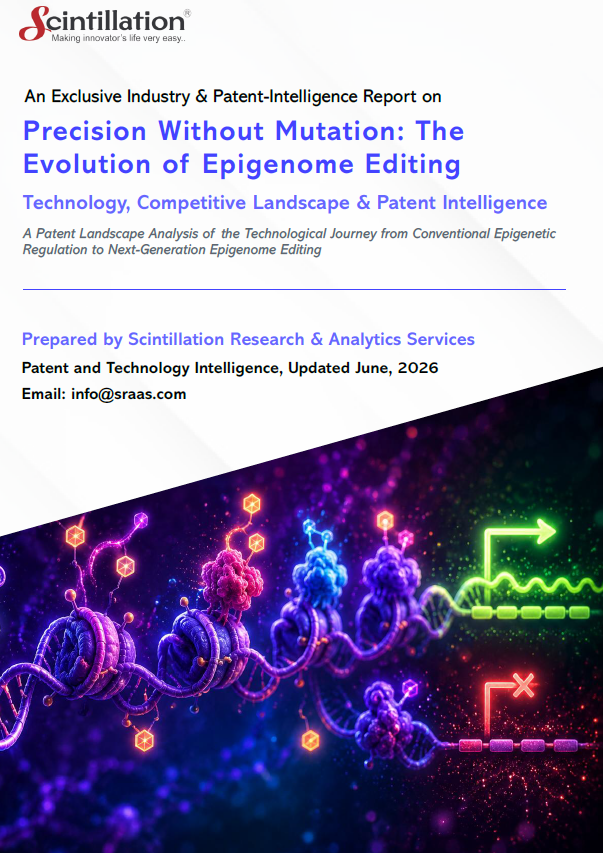
Precision Without Mutation:
The Evolution of Epigenome Editing

A comprehensive technology and patent intelligence analysis of epigenome editing as a next-generation platform for precise, reversible control of gene expression — examining scientific foundations, therapeutic applications, leading innovators, and the evolving intellectual-property landscape shaping programmable gene regulation.

No DNA cutsReversible expression control
CRISPR+Next-gen beyond gene editing
ClinicalEntering trial phases
8-partPatent landscape analysis

Report details

Precision Without Mutation: The Evolution of Epigenome Editing

Publisher Scintillation Research
Technology Epigenome Editing
Core approaches DNA methylation, histone modification, transcriptional regulation
IP coverage 8-part patent landscape
Applications Therapeutics, genetic disease, oncology
Chapters 12 structured chapters
Audience IP, R&D, Clinical, Investment
No DNA sequence alteration
3 Core modality types
Clinical Trial stage entry
8 Patent landscape sections
360° IP & competitive coverage
Introduction

Rewriting gene expression without rewriting DNA

Epigenome editing is emerging as a transformative approach in clinical treatment, enabling precise modifications to gene expression without altering the underlying DNA sequence.

The ongoing transition of epigenome editing techniques from foundational research to clinical applications highlights several key strategies — including targeted DNA methylation and demethylation, histone modification, and transcriptional regulation. These approaches offer the potential for durable and reversible gene expression modulation, paving the way for precisely tailored therapies for genetic and complex diseases.

In the past decade, targeted genome editing technologies have undergone remarkable advancements, solidifying their role as indispensable tools in the exploration of gene function and the treatment of various chronic and genetic disorders. These groundbreaking methodologies have increasingly entered clinical trial phases, signaling a transformative shift in the field of genetics.

Unlike conventional gene editing approaches that make permanent cuts to the DNA sequence, epigenome editing operates at the level of gene regulation — modifying the chemical marks on DNA and histones that control which genes are active, without changing the genetic code itself. This distinction opens entirely new therapeutic possibilities: conditions previously untreatable by gene editing become accessible to precise, potentially reversible intervention through epigenetic reprogramming.

Report structure

Table of contents

Twelve chapters connecting epigenome editing's scientific foundations to patent landscape intelligence, therapeutic applications, and IP strategy. Click any chapter to expand its sections.

Condensed findings on epigenome editing technology, key patent holders, filing trends, and strategic implications for gene regulation and epigenetic medicine
2.1 Who Will Benefit from This Report — molecular biologists, IP counsel, biotech investors, clinical researchers, pharma strategists, and gene therapy professionals
3.1 Limitations of Conventional Gene Regulation Technologies — permanence of DNA edits, off-target risk, immune response, delivery constraints, and lack of reversibility
Core components of epigenome editing systems — CRISPR-based effectors, zinc fingers, TALEs, targeting domains, and epigenetic writer/eraser enzymes
4.1 Challenges Addressed — off-target mutagenesis, permanent gene disruption, immunogenicity, delivery limitations, and epigenetic dysregulation in disease
4.2 Key Features — reversibility, no DSB requirement, durable silencing, programmable targeting, multiplexing capability, and tissue-specific delivery
4.3 Applications — monogenic diseases, oncology, neurological disorders, metabolic disease, autoimmune conditions, and epigenetic reprogramming
Historical progression from first-generation epigenetic tools to CRISPR-based effectors; platform generations, delivery evolution, and clinical translation milestones
Competitive advantages over gene editing, untapped disease addressable market, platform scalability, and convergence with synthetic biology and cell therapy
Clinical pipeline trajectory, platform company emergence, licensing dynamics, regulatory pathway considerations, and long-term therapeutic market outlook
8.1 Methodology & Scope — patent database coverage, search strategy, classification framework, and analytical approach for epigenome editing IP
8.2 Interesting Strategic Insights — cross-cutting IP themes, licensing concentration risks, platform overlap, and emerging competitive dynamics
8.3 Assignee Picture — leading patent filers across academic institutions, biotech companies, pharma, and research foundations with detailed assignee profiles
8.4 Filing Activity Over Time — trend analysis identifying R&D acceleration and IP maturity signals in epigenome editing technology
8.5 Jurisdiction Coverage — USPTO, EPO, WIPO, CNIPA, KIPO, and regional patent office distributions across the epigenome editing landscape
8.6 Technology Segmentation — patents mapped to DNA methylation, demethylation, histone acetylation, methylation, CRISPR effectors, delivery systems, and targeting domains
8.7 Representative Publications Across the Field — key academic and industry publications shaping epigenome editing research direction and clinical translation
8.8 Whitespace & Strategic Opportunities — unprotected technology domains and emerging filing opportunities across the epigenome editing IP landscape
Stakeholder-specific takeaways for molecular biologists, IP counsel, biotech investors, clinical teams, pharma business development, and gene therapy professionals
Synthesis of epigenome editing's scientific trajectory, IP landscape dynamics, and strategic implications for the future of programmable gene regulation
Publisher profile, research methodology, and service overview — patent analytics, technology scouting, competitive intelligence, and strategic research
Full legal disclaimer covering information accuracy, IP ownership, clinical claims, and terms of use for this intelligence report
Technology

Core components & key features

Epigenome editing systems combine programmable DNA-targeting domains with epigenetic effector enzymes to achieve precise, reversible control of gene expression — without making double-strand breaks in the genome.

DNA methylation & demethylation
Targeted addition or removal of methyl groups on cytosine residues to silence or activate specific genes — the foundational epigenetic control mechanism in mammalian cells.
Histone modification
Programmable acetylation, methylation, phosphorylation, and ubiquitination of histone tails to remodel chromatin architecture and regulate transcriptional access to target genes.
CRISPR-based epigenetic effectors
dCas9 and Cas12 platforms fused to epigenetic writer or eraser enzymes, enabling programmable targeting of any genomic locus with guide RNA precision.
Transcriptional activation & repression
VPR, KRAB, and related transactivation/repression domains enabling potent, durable up- or down-regulation of target genes independent of DNA methylation state.
Reversibility & tunability
Unlike gene editing, epigenome edits can be reversed or adjusted — enabling dynamic therapeutic dosing strategies and reducing the risk of permanent off-target consequences.
Zinc finger & TALE platforms
Established protein-based targeting platforms for epigenetic effector delivery — offering high specificity for validated disease-relevant loci with minimal immunogenicity.
In vivo delivery systems
AAV vectors, lipid nanoparticles, and emerging non-viral delivery platforms engineered for tissue-specific and cell-type-specific epigenome editor delivery in vivo.
Multiplexed epigenetic reprogramming
Simultaneous targeting of multiple genomic loci for complex regulatory circuit modulation — enabling synthetic epigenetic programs for cell fate control and disease correction.
Challenges addressed

Limitations of conventional gene regulation technologies

Epigenome editing directly addresses five fundamental constraints that limit the therapeutic utility of conventional gene editing and RNA-based approaches.
01
Permanent DNA sequence alteration
CRISPR-Cas9 gene editing creates irreversible double-strand breaks, raising safety concerns for conditions that may benefit from adjustable or reversible intervention. Epigenome editing achieves gene silencing or activation without altering the DNA sequence
Reversibility
02
Off-target mutagenesis risk
Nuclease-based editing carries the risk of unintended mutations at off-target genomic sites. Epigenome editing with catalytically inactive effectors eliminates mutagenesis risk while retaining programmable gene regulation capability
Safety
03
Limited applicability to non-coding disease
Many diseases arise from dysregulated gene expression rather than protein-coding mutations — domains beyond conventional gene editing's reach. Epigenome editing directly addresses regulatory element dysfunction across the non-coding genome
Scope
04
Immune response to edited cells
Gene-edited cells expressing foreign proteins can trigger immune rejection. Epigenome editing approaches that avoid immunogenic effector proteins or use endogenous regulatory mechanisms may reduce this barrier to durable therapeutic efficacy
Immunology
05
Inability to modulate expression dynamically
Conventional editing offers binary outcomes — gene disruption or correction. Epigenome editing enables tunable, dose-responsive gene expression control — critical for diseases requiring titrated therapeutic modulation rather than complete gene knockout
Tunability

Download Your Sample Report Now:

    Applications

    Therapeutic & research applications

    Epigenome editing's precision and reversibility open therapeutic avenues across diseases driven by gene misregulation — particularly those beyond the reach of conventional sequence-editing approaches.

    Rare & Monogenic Disease
    Targeted gene silencing for gain-of-function disorders
    Epigenetic silencing of dominant-negative or toxic gain-of-function alleles in conditions including Huntington's disease, dominant retinal dystrophies, and ATTR amyloidosis — without disrupting the wild-type allele.
    Oncology
    Tumor suppressor reactivation & oncogene silencing
    Targeted demethylation of silenced tumor suppressor gene promoters and epigenetic repression of oncogenic transcription factors — complementing existing cancer immunotherapy and targeted therapy approaches.
    Neurological Disorders
    Epigenetic modulation of neuronal gene expression
    Programmable activation of neuroprotective genes and silencing of disease-driving pathways in conditions including Alzheimer's, Parkinson's, Angelman syndrome, and Rett syndrome.
    Metabolic Disease
    Hepatic gene regulation for metabolic correction
    In vivo epigenome editing in liver tissue to durably suppress PCSK9, angiopoietin-like proteins, and other metabolic regulators — extending beyond RNA interference with durable single-dose epigenetic correction.
    Autoimmune & Inflammatory Disease
    Immune cell epigenetic reprogramming
    Targeted epigenetic modulation of cytokine gene loci and immune regulatory networks in T cells, macrophages, and dendritic cells for durable immunomodulation without systemic immunosuppression.
    Cell Therapy & Regenerative Medicine
    Ex vivo epigenetic reprogramming of therapeutic cells
    Epigenome editing of CAR-T cells, iPSCs, and stem cell populations to enhance persistence, reduce exhaustion, improve engraftment, and encode durable therapeutic phenotypes for next-generation cell therapies.
    Patent intelligence

    The epigenome editing patent landscape — an 8-part analysis

    The patent landscape chapter delivers data-grounded IP intelligence across the epigenome editing ecosystem — from assignee profiling and filing trends to strategic insights, whitespace identification, and representative publications.

    Assignee & filing intelligence
    • Methodology and scope defining the patent search universe for epigenome editing and programmable gene regulation
    • Interesting strategic insights — cross-cutting IP themes, licensing concentration risks, and competitive dynamics
    • Detailed assignee picture — academic institutions, biotech companies, pharma, and research foundations with profiles
    • Filing activity over time — trend analysis identifying R&D acceleration and technology maturity signals
    Technology & strategic analysis
    • Jurisdiction coverage — USPTO, EPO, WIPO, CNIPA, KIPO, and regional patent office distributions
    • Technology segmentation — DNA methylation, histone modification, CRISPR effectors, targeting domains, delivery systems
    • Representative publications — key academic and industry publications shaping epigenome editing research direction
    • Whitespace & strategic opportunities — unprotected technology domains and emerging filing opportunities
    Who will benefit

    Who should read this report

    Molecular Biologists & Epigenetics Researchers
    Scientists working on CRISPR-based epigenetic effectors, histone modification tools, DNA methylation systems, and chromatin remodeling for therapeutic or research applications.
    IP Counsel & Patent Teams
    Attorneys and patent professionals assessing epigenome editing portfolio positioning, whitespace, freedom-to-operate, and filing strategy across gene regulation and epigenetic medicine.
    Biotech & Pharma Investors
    Investment professionals tracking the epigenome editing ecosystem, clinical pipeline, competitive dynamics, and emerging IP positions across platform companies and academic spinouts.
    Clinical & Translational Researchers
    Scientists and clinical teams evaluating epigenome editing modalities for IND-enabling studies, clinical trial design, and therapeutic application development across disease areas.
    Business Development & Licensing Teams
    Pharma and biotech BD professionals evaluating epigenome editing IP portfolios, platform licensing opportunities, and acquisition targets across the gene regulation landscape.
    Gene Therapy & Cell Therapy Strategists
    Teams at AAV gene therapy, CAR-T, and iPSC companies assessing epigenome editing integration for enhanced therapeutic cell manufacturing and in vivo delivery platforms.
    Technology & Patent Intelligence · Scintillation Research

    Understand the IP landscape shaping programmable gene regulation

    Get the complete technology and patent intelligence report on epigenome editing — from scientific foundations and therapeutic applications to the patent landscape defining the future of precision gene regulation without mutation.

    Scintillation Research · Epigenome Editing · Patent Intelligence Series

    For a quick demo, schedule a meeting now!

    Service Demo Booking
    About

    About Scintillation Research

    Scintillation Research & Analytics Services is a specialized intellectual property and technology intelligence firm delivering patent analytics, technology scouting, competitive intelligence, and strategic research services.

    Through comprehensive patent and technology intelligence reports, we help organizations understand emerging innovations, identify market opportunities, monitor competitors, and make data-driven decisions across rapidly evolving technology domains. Our reports are designed for professionals at the intersection of technology strategy, IP management, and competitive intelligence.

    Shopping Cart (0 items)

    Subscribe to our newsletter

    Sign up to receive latest news, updates, promotions, and special offers delivered directly to your inbox.
    No, thanks
    Select your currency