Quantum Resistant Banking

  • Home
  • Quantum Resistant Banking
Quantum Resistant Banking: Can Financial Transactions Remain Trustworthy in a Post-Quantum World? | Scintillation Research
Patent Intelligence Report  ·  Financial Cybersecurity Series

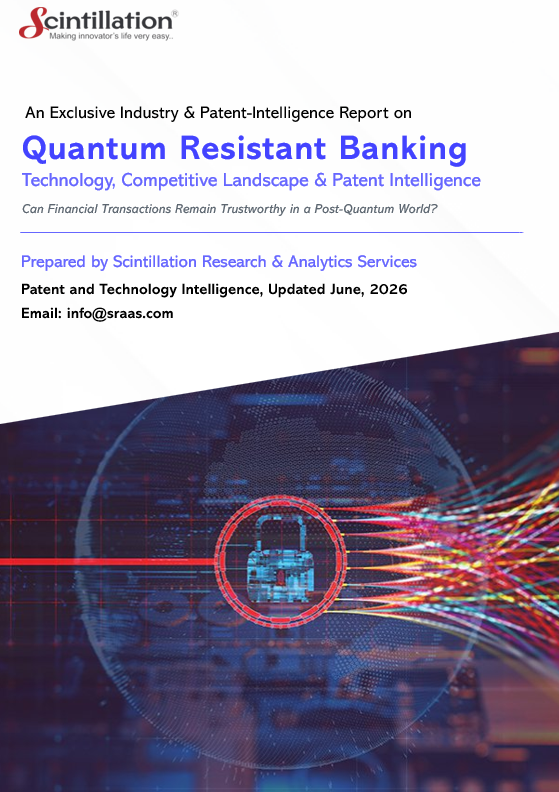
Quantum Resistant Banking: Can Financial Transactions Remain Trustworthy in a Post-Quantum World?

A data-grounded look at who is filing, where innovation is concentrated, and why quantum-resistant security is becoming an urgent priority for global finance.

A comprehensive technology and patent intelligence analysis of Quantum-Resistant Banking — examining post-quantum cryptography (PQC), hybrid cryptographic schemes, quantum key distribution (QKD), "harvest now, decrypt later" risk mitigation, and legacy-system migration strategies enabling financial institutions to defend transactions, customer data, and core banking infrastructure against quantum-enabled attacks.

PQCPost-quantum cryptography
HNDLHarvest now, decrypt later risk
QKDQuantum key distribution
PatentLandscape & whitespace analysis

Report details

Quantum Resistant Banking — Technology & Patent Intelligence Report

Publisher Scintillation Research
Technology Quantum-Resistant Banking
Focus area Post-Quantum Financial Security
Key segments PQC, Hybrid Crypto, QKD, Migration
IP coverage Patent landscape study
Applications Banking, Payments, Core Infrastructure
Audience IP, R&D, Strategy, Investment
PQC Post-quantum cryptography
HNDL Harvest now, decrypt later risk
QKD Quantum key distribution
IP Patent landscape study
Hybrid Classical + quantum-safe schemes
Introduction

When today's encryption can no longer guarantee tomorrow's financial security

Quantum computers, should they reach sufficient size and power, may be able to break the encryption schemes widely used today to secure financial transactions, communication, and data. This makes quantum computing one of the most significant cybersecurity threats facing the financial system, potentially exposing financial transactions to attack.

While it is still unclear when quantum computing technology might be adopted on a large scale, its potential as a cyber threat to the financial system is already a matter of concern. Malicious actors can intercept and store confidential, classically encrypted data with the intention of decrypting it later when quantum computers become powerful enough to do so. This means that data stored or transmitted today is, in fact, exposed to "harvest now, decrypt later" attacks by a future quantum computer.

To address these risks, the financial sector needs to pre-emptively implement robust communication and data protection technologies. Given the long-term sensitivity of financial data and the complexity of IT systems, a transition phase should be initiated well in advance to enable the implementation of quantum-resistant encryption schemes.

Report structure

Table of contents

Ten chapters connecting quantum-resistant banking's technical foundations to patent landscape intelligence and migration strategy. Click any chapter to expand.

Condensed findings on quantum-resistant banking technology, patent filing trends, assignee dynamics, and strategic implications for post-quantum financial security IP
Who Will Benefit from This Report — cybersecurity teams, banking technology strategists, IP counsel, regulators, and technology investors tracking post-quantum financial security
3.1 Challenges in Conventional Data Security Algorithms in Financial Sectors — vulnerability of widely deployed encryption schemes to quantum attack and exposure to harvest-now-decrypt-later tactics
Structural Components of Quantum-Resistant Banking Technology — post-quantum cryptographic algorithms, hybrid key-exchange systems, quantum key distribution channels, and legacy-system migration layers
4.1 Key Features — quantum-safe encryption strength, backward compatibility with existing banking infrastructure, hybrid classical-quantum security, and crypto-agility
4.2 Problems Quantum-Resistant Banking Aims to Solve — harvest-now-decrypt-later exposure, legacy cryptographic vulnerability, and long-term data confidentiality risk
4.3 Potential Applications — core banking infrastructure, payment networks, customer data protection, and interbank communication systems
Traditional Banking Security vs Quantum-Resistant Banking Technology — comparative analysis of cryptographic resilience, migration complexity, and long-term security guarantees
Quantum-resistant migration roadmap, regulatory timelines, banking-sector adoption pathways including in markets such as India, and near-term commercialization opportunities
6.1 Methodology & Scope — patent database coverage, search strategy, classification framework, and analytical approach for quantum-resistant banking IP
6.2 Assignee Picture — leading filers across financial institutions, cryptography specialists, and technology vendors, with notable assignee profiles
6.3 Filing Activity Over Time — trend analysis identifying R&D acceleration and IP maturity signals across quantum-resistant banking technology domains
6.4 Jurisdiction Coverage — USPTO, CNIPA, KIPO, JPO, EPO, and WIPO distributions across the quantum-resistant banking patent landscape
6.5 Technology Segmentation — patents mapped to post-quantum cryptography, hybrid cryptographic schemes, quantum key distribution, and migration tooling
6.6 Foundational Anchor Patents — core IP defining the quantum-resistant banking landscape and their strategic competitive significance
6.7 Whitespace & Strategic Opportunities — underprotected technology domains and emerging filing opportunities across the quantum-resistant banking IP ecosystem
Stakeholder-specific takeaways for cybersecurity teams, banking technology strategists, IP counsel, regulators, and technology investors
Synthesis of quantum-resistant banking's technical trajectory, IP landscape dynamics, and strategic implications for financial-sector security in a post-quantum world
Publisher profile, research methodology, and service overview — patent analytics, technology scouting, competitive intelligence, and strategic research across financial cybersecurity domains
Full legal disclaimer covering information accuracy, IP ownership, and terms of use for this intelligence report
Inside Quantum-Resistant Banking Technology

Structural components & key features

Quantum-resistant banking technology layers new cryptographic primitives and key-distribution mechanisms onto existing financial infrastructure — designed to remain secure against both classical and quantum-enabled attacks while supporting a phased migration away from legacy encryption.

Post-quantum cryptography (PQC)
Cryptographic algorithms based on mathematical problems believed to resist attack by both classical and quantum computers — including lattice-based, hash-based, and code-based encryption schemes.
Hybrid cryptographic schemes
Combined classical and post-quantum encryption layers deployed together during the transition period, ensuring security even if one cryptographic approach is later compromised.
Quantum key distribution (QKD)
Physical-layer key-exchange systems using quantum properties of photons to detect eavesdropping and establish encryption keys with information-theoretic security guarantees.
Harvest-now-decrypt-later risk mitigation
Architectures and key-rotation strategies designed to limit the value of data intercepted today for future decryption once quantum computers reach cryptographically relevant scale.
Crypto-agility frameworks
Architectural patterns that allow banking systems to swap cryptographic algorithms without major system redesign — critical for adapting quickly as PQC standards evolve.
Legacy-system migration tooling
Discovery, inventory, and phased-rollout tools that identify cryptographic dependencies across core banking infrastructure and manage the transition to quantum-safe algorithms.
Quantum-safe digital signatures
Signature schemes resistant to quantum attack, securing transaction authentication, identity verification, and non-repudiation across financial messaging systems.
Continuous cryptographic risk monitoring
Ongoing assessment systems tracking quantum-computing progress and emerging cryptanalytic threats to inform the pace and prioritization of migration efforts.
Challenges addressed

Why conventional data security algorithms cannot meet the quantum threat

Quantum-resistant banking directly targets the structural vulnerabilities that quantum computing introduces into financial cryptography — while confronting the practical challenges of migrating complex, deeply embedded legacy infrastructure.

01
Vulnerability of widely deployed encryption
Public-key cryptographic schemes underpinning most financial systems today rely on mathematical problems that a sufficiently powerful quantum computer could solve efficiently, undermining the security guarantees these systems were built on
Cryptographic vulnerability
02
Harvest-now-decrypt-later exposure
Encrypted financial data intercepted and stored today remains exposed to future decryption once quantum computers reach sufficient capability, meaning the threat window has already opened even though large-scale quantum computing has not yet arrived
HNDL risk
03
Legacy infrastructure migration complexity
Core banking systems are deeply embedded with classical cryptographic dependencies across decades-old infrastructure, making a full transition to quantum-safe algorithms technically complex and operationally risky if rushed
Migration complexity
04
Uncertain adoption timelines
The exact timeline for cryptographically relevant quantum computing remains uncertain, complicating decisions about how aggressively financial institutions should prioritize and fund migration efforts relative to other security investments
Timeline uncertainty
05
Long-term data sensitivity
Financial data often requires confidentiality protection spanning years or decades, meaning systems must be secured against threats that may not materialize for many years — requiring proactive rather than reactive security investment
Data sensitivity
Traditional vs quantum-resistant

Traditional banking security vs quantum-resistant banking technology

A side-by-side view of how quantum-resistant approaches differ from the cryptographic foundations most financial institutions currently rely on.

Dimension Traditional Banking Security Quantum-Resistant Banking Technology
Cryptographic basis RSA, ECC, and other classical public-key schemes Lattice-based, hash-based, and code-based PQC algorithms
Quantum vulnerability Susceptible to efficient quantum algorithms such as Shor's algorithm Designed to resist known quantum cryptanalytic techniques
HNDL exposure Data encrypted today remains at risk of future decryption Reduces long-term exposure to harvested ciphertext
Migration approach Stable, mature, widely standardized infrastructure Often deployed via hybrid schemes during a phased transition
Standardization maturity Decades of established standards and interoperability Emerging standards (e.g., NIST PQC selections) still maturing across vendors
Key distribution Classical key-exchange protocols Can incorporate quantum key distribution for physical-layer security

Download Your Sample Report Now:

    Application areas

    Where quantum-resistant banking creates critical security impact

    Quantum-resistant cryptography's protective value is most critical in applications where financial data sensitivity, transaction volume, and regulatory exposure make long-term cryptographic failure most costly.

    Core Banking Infrastructure
    Account systems, ledgers, and internal banking platforms requiring long-term cryptographic protection of customer and transaction data
    Payment Networks
    Card, wire, and real-time payment systems where transaction authentication integrity must withstand future quantum-enabled forgery attempts
    Interbank Communication
    SWIFT-style messaging and interbank settlement systems requiring quantum-safe encryption for cross-institution data exchange
    Customer Data Protection
    Personally identifiable and financial information requiring confidentiality guarantees that extend well beyond near-term quantum computing timelines
    Digital Identity & Authentication
    Customer authentication and digital signature systems requiring quantum-safe verification of identity and transaction authorization
    Regulatory Compliance & Risk Management
    Compliance functions tracking evolving quantum-readiness mandates from financial regulators and central banks
    Central Bank Digital Currency Systems
    Emerging CBDC infrastructure requiring quantum-resistant security built in from initial design rather than retrofitted later
    Cross-Border & Emerging-Market Banking
    Banking sectors in markets such as India evaluating phased quantum-resistant adoption pathways suited to local infrastructure constraints
    Patent intelligence

    The quantum-resistant banking patent landscape

    The patent landscape chapter delivers data-grounded IP intelligence — from methodology and assignee profiling to filing trends, jurisdiction coverage, technology segmentation, anchor patents, and whitespace identification across the full quantum-resistant banking ecosystem.

    Filing & jurisdiction intelligence
    • Methodology and scope defining the boundaries of quantum-resistant banking patent analysis
    • Assignee picture and notable profiles — financial institutions, cryptography specialists, and technology vendors shaping the quantum-resistant banking IP landscape
    • Filing activity over time — trend analysis identifying R&D acceleration points and IP maturity signals across the technology domain
    • Jurisdiction coverage — USPTO, CNIPA, KIPO, JPO, EPO, and WIPO distributions across the quantum-resistant banking patent corpus
    Technology & strategic analysis
    • Technology segmentation — post-quantum cryptography, hybrid cryptographic schemes, quantum key distribution, and migration tooling
    • Foundational anchor patents — core IP defining the quantum-resistant banking landscape and their strategic competitive significance
    • Whitespace & strategic opportunities — underprotected technology domains and emerging filing and licensing opportunities
    • Strategic implications for freedom-to-operate, partnership, and acquisition decisions across the quantum-resistant banking ecosystem
    Who will benefit

    Who should read this report

    Cybersecurity & Cryptography Teams
    Technical teams designing post-quantum cryptographic algorithms, hybrid key-exchange systems, and migration tooling for banking infrastructure.
    Banking Technology Strategists
    Technology leaders at financial institutions evaluating quantum-readiness roadmaps, legacy-system migration timelines, and vendor selection.
    IP Counsel & Patent Teams
    Attorneys and patent professionals assessing portfolio positioning, whitespace, freedom-to-operate, and filing strategy across PQC, hybrid cryptography, and QKD technologies.
    Regulators & Compliance Officers
    Regulatory bodies and compliance teams tracking quantum-readiness mandates and developing supervisory expectations for financial-sector migration.
    Technology Investors
    Investment professionals tracking the post-quantum security ecosystem, the quantum-resistant banking IP landscape, and emerging companies in PQC and QKD technology.
    R&D Strategists & Industry Analysts
    Researchers and consultants mapping the competitive quantum-resistant banking landscape across financial institutions, cryptography vendors, and technology providers driving adoption.
    Technology & Patent Intelligence · Scintillation Research

    Understand who is building the IP foundation for post-quantum financial security

    Get the complete technology and patent intelligence report on Quantum-Resistant Banking — from post-quantum cryptography and hybrid schemes to the patent landscape revealing who is filing, where innovation is concentrated, and why quantum-resistant security is becoming an urgent priority for global finance.

    Scintillation Research · Quantum Resistant Banking · Patent Intelligence Series

    For a quick demo, schedule a meeting now!

    Service Demo Booking
    About

    About Scintillation Research

    Scintillation Research & Analytics Services is a specialized intellectual property and technology intelligence firm delivering patent analytics, technology scouting, competitive intelligence, and strategic research services.

    Through comprehensive patent and technology intelligence reports, we help organizations understand emerging innovations, identify market opportunities, monitor competitors, and make data-driven decisions across rapidly evolving technology domains. Our reports are designed for professionals at the intersection of technology strategy, IP management, and competitive intelligence.

    Shopping Cart (0 items)

    Subscribe to our newsletter

    Sign up to receive latest news, updates, promotions, and special offers delivered directly to your inbox.
    No, thanks
    Select your currency