
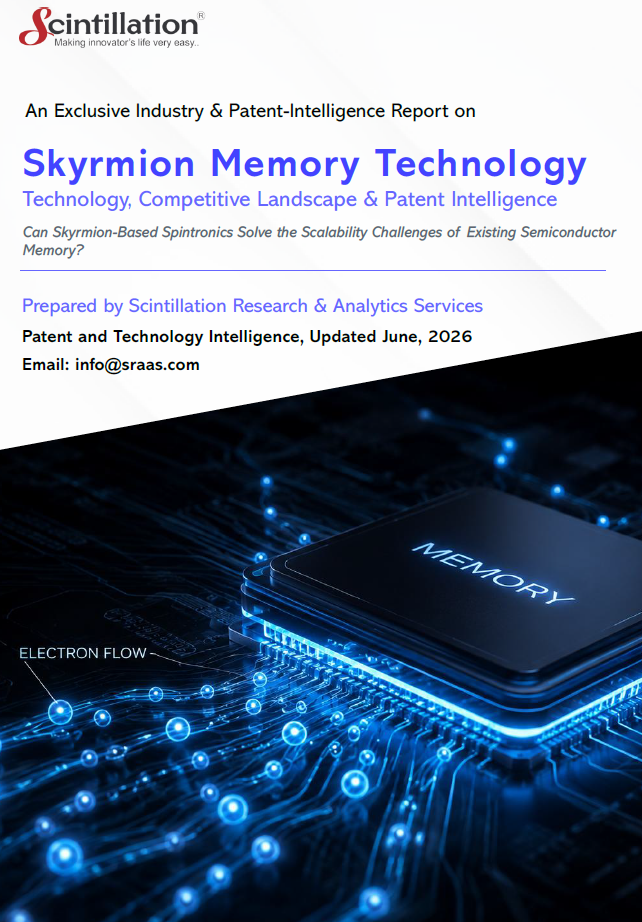
Skyrmion Memory Technology: Can Skyrmion-Based Spintronics Solve the Scalability Challenges of Existing Semiconductor Memory?
A data-grounded look at who is filing, where innovation is concentrated, and why skyrmion-based spintronics is emerging as a leading candidate for ultra-low-power, high-density memory.
A comprehensive technology and patent intelligence analysis of Skyrmion Memory Technology — examining skyrmion racetrack memory, skyrmion creation, manipulation and detection mechanisms, the skyrmion Hall effect, material engineering approaches, and fabrication pathways enabling next-generation, energy-efficient spintronic computing systems.
Report details
Skyrmion Memory Technology — Technology & Patent Intelligence Report
When conventional semiconductor memory can no longer meet the scalability and energy demands of next-generation computing
A research team led by the Agency for Science, Technology and Research (A*STAR) in partnership with the National University of Singapore (NUS) has created an innovative microelectronic device that can potentially function as a sustainable, high-performance "bit-switch." This paves the way for future computing technologies to process data much faster while using significantly less energy.
By harnessing tiny, stable and speedy magnetic whirls called skyrmions, the device can operate using 1,000 times less power than commercial memory technologies. This discovery was reported in the journal Nature.
Solitonic magnetic excitations such as domain walls and, specifically, skyrmions enable the possibility of compact, high-density, ultrafast, all-electronic, low-energy devices, which is the basis for the emerging area of skyrmionics. The topological winding of skyrmion spins affects their overall lifetime, energetics, and dynamical behaviour. This report discusses skyrmionics in the context of the present-day solid-state memory landscape, and shows how their size, stability, and mobility can be controlled by material engineering, as well as how they can be nucleated and detected.
Table of contents
Ten chapters connecting skyrmion memory's technical foundations to patent landscape intelligence and commercialization strategy. Click any chapter to expand.
Structural components & key features
Skyrmion memory stores information not as electrical charge but as the position of topologically stable, nanoscale magnetic whirls within a thin-film racetrack — enabling current-driven data movement with dramatically lower energy requirements than conventional charge-based memory.
Why conventional semiconductor memory cannot meet next-generation scaling demands
Skyrmion memory directly targets the structural constraints that limit how far conventional charge-based semiconductor memory can continue to scale — while confronting new technical hurdles of its own around drift control and material engineering.
Conventional memory technology vs skyrmion memory technology
A side-by-side view of how skyrmion-based spintronic memory differs from the charge-based memory architectures that dominate today's semiconductor industry.
| Dimension | Conventional Memory Technology | Skyrmion Memory Technology |
|---|---|---|
| Information carrier | Electrical charge stored in capacitors or transistors | Position of topologically stable magnetic skyrmions |
| Power consumption | Relatively high switching energy per bit | Demonstrated reductions of up to 1,000x in research settings |
| Data density | Constrained by charge-storage cell size and leakage | Potentially higher density via nanoscale skyrmion size |
| Stability mechanism | Relies on charge retention and refresh cycles (for volatile memory) | Inherent topological protection provides structural stability |
| Switching mechanism | Voltage-driven charge transfer | Current-driven spin-torque motion along a racetrack |
| Technology maturity | Decades of established fabrication and manufacturing infrastructure | Emerging technology with active research into fabrication and room-temperature operation |
Download Your Sample Report Now:
Where skyrmion memory creates emerging computational impact
Skyrmion memory's power, density, and stability advantages are most compelling in applications where conventional charge-based memory faces fundamental energy, scaling, or footprint constraints.
The skyrmion memory patent landscape
The patent landscape chapter delivers data-grounded IP intelligence — from methodology and assignee profiling to filing trends, jurisdiction coverage, technology segmentation, anchor patents, and whitespace identification across the full skyrmion memory ecosystem.
- Methodology and scope defining the boundaries of skyrmion memory patent analysis
- Assignee picture and notable profiles — semiconductor manufacturers, research institutions, and academic consortia shaping the skyrmion memory IP landscape
- Filing activity over time — trend analysis identifying R&D acceleration points and IP maturity signals across skyrmion memory technology segments
- Jurisdiction coverage — USPTO, CNIPA, KIPO, JPO, EPO, and WIPO distributions across the skyrmion memory patent corpus
- Technology segmentation — racetrack memory, nucleation and creation mechanisms, manipulation and motion control, and detection techniques
- Foundational anchor patents — core IP defining the skyrmion memory landscape and their strategic competitive significance
- Whitespace & strategic opportunities — underprotected technology domains and emerging skyrmion memory filing and licensing opportunities
- Strategic implications for freedom-to-operate, partnership, and research-collaboration decisions across the skyrmion memory ecosystem
Who should read this report
Understand who is building the IP foundation for skyrmion-based spintronic memory
Get the complete technology and patent intelligence report on Skyrmion Memory Technology — from racetrack memory architectures and nucleation mechanisms to the patent landscape revealing who is filing, where innovation is concentrated, and why skyrmion-based spintronics is emerging as a leading candidate for ultra-low-power, high-density memory.
For a quick demo, schedule a meeting now!
About Scintillation Research
Scintillation Research & Analytics Services is a specialized intellectual property and technology intelligence firm delivering patent analytics, technology scouting, competitive intelligence, and strategic research services.
Through comprehensive patent and technology intelligence reports, we help organizations understand emerging innovations, identify market opportunities, monitor competitors, and make data-driven decisions across rapidly evolving technology domains. Our reports are designed for professionals at the intersection of technology strategy, IP management, and competitive intelligence.
