
Hubble Network Raised $30M: 12 Granted Patents, 14 Application Records — What Its IP Says About the Company’s Next Move
Hubble Network is building a business around extending the reach of ordinary Bluetooth devices. Its patent portfolio raises a related commercial question: as more companies connect devices across terrestrial and satellite networks, where could Hubble’s technology become strategically relevant?
On 18 August 2026, Seraphim Space Investment Trust announced a $30 million investment in Hubble Network. The ambition was clear: extend connectivity to existing Bluetooth devices across markets such as asset tracking, logistics and industrial monitoring. Investment announcement.
Behind that funding story is a patent position worth examining.
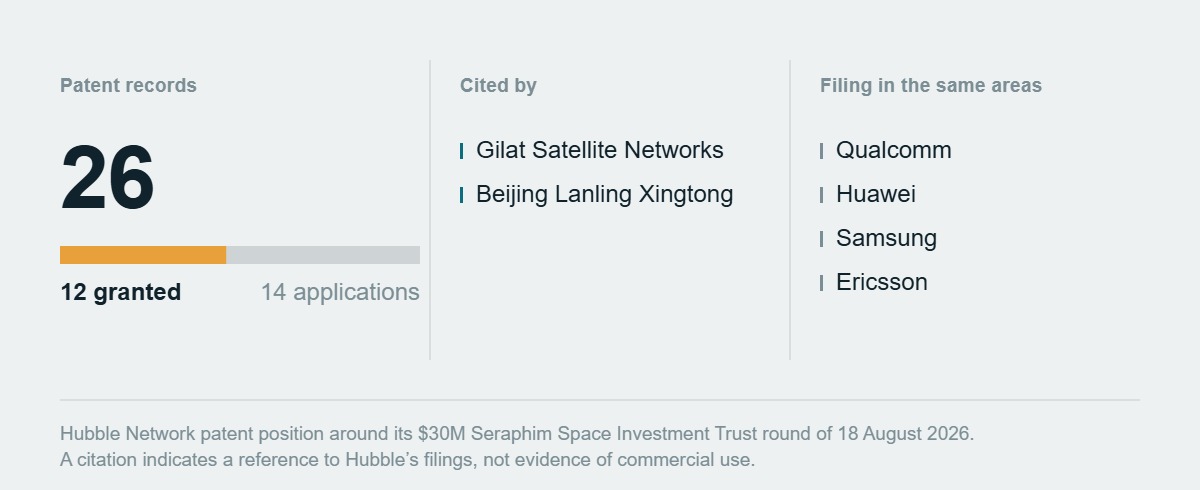
The portfolio figures used for this analysis identify 26 patent and publication records: 12 granted patents and 14 application records.
Those numbers provide the starting point. The more interesting story is how the technology described in the portfolio connects with the business Hubble is building—and with the products other companies may develop around it.
A patent position with a commercial question attached
Twelve granted patents give the analysis an existing set of issued claims to examine alongside the application record.
For Hubble, the strategic question is how those claims relate to the practical problems its network is designed to solve. Which aspects of connecting, locating and tracking devices do they address? Which implementations could become important as the network expands?
Answering those questions turns a portfolio count into something a founder can use: a clearer view of where the company’s IP may support its commercial position.
It also establishes the foundation for investigating opportunities beyond Hubble’s own products.
The technology story: connecting devices and keeping them visible
The filing titles in the research point to several related subjects: tracking palletized goods with tags, combining terrestrial and satellite networks, and satellite structures for launch.
Together, they suggest a business whose technical challenge extends across several layers—from the device being tracked to the infrastructure carrying its signal.
Consider an asset moving through a supply chain. It may pass through a warehouse, travel over a road network and eventually reach a location with limited conventional connectivity. Its owner still wants to know where it is.
That continuity is the commercial problem around which Hubble’s story becomes interesting.
Hubble’s current website describes a live terrestrial network, with satellite connectivity presented as an upcoming extension. That makes the relationship between the two networks an especially useful subject to follow as the offering develops. Hubble’s product overview.
The closer the patent claims sit to the functions customers depend on, the more strategically interesting the portfolio becomes.
A small portfolio in a much larger wireless neighborhood
The research places Hubble’s filings in broad technology areas that also attract companies such as Qualcomm, Huawei, Samsung and Ericsson.
That gives the portfolio context. These are fields with substantial engineering investment and established patent activity.
It also sharpens the question for a younger company: where does its particular contribution sit within that larger body of technology?
Broad patent classifications help locate that neighborhood. Understanding Hubble’s position requires a closer examination of the claims and the implementations they describe.
A large wireless company appearing nearby is therefore a starting point for research. The commercial significance emerges when a specific product, technical feature or development direction makes the comparison worth pursuing.
For Hubble, that could mean watching how other businesses approach device tracking, low-power connectivity and integration between terrestrial and satellite systems.
The early signals are worth following
The citation research supplied for this feature identifies organizations whose patent records reference Hubble’s work, including Beijing Lanling Xingtong and Gilat Satellite Networks.
Those references offer leads for a closer look: which inventions were cited, in what context, and whether subsequent filings continue developing related subject matter.
A citation alone does not establish commercial use. Its usefulness grows when it can be considered alongside other evidence.
A company publishes a related application. Later, it announces a product with relevant functionality. Its technical documentation then provides enough detail to investigate the relationship to an issued claim.
That sequence can turn an isolated reference into a meaningful intelligence question.
The opportunity lies in recognizing when several developments begin pointing toward the same company, product or market.
What happens next may matter more than what exists today
Hubble’s current patent position provides a baseline. The next layer of intelligence comes from following changes around it.
Which companies introduce new approaches to connecting Bluetooth devices beyond conventional coverage?
Where do new applications appear around combined terrestrial and satellite networking?
Which tracking products begin adding functions that warrant comparison with Hubble’s issued claims?
And how does Hubble’s own application record develop as its commercial offering expands?
Following those developments can help distinguish a passing resemblance from a subject deserving deeper investigation.
It can also reveal opportunities that a static competitor list would miss. A future partner or potential licensing counterparty may emerge from an adjacent market, through a new product or integration, rather than from the companies Hubble considers its closest competitors today.
Where the commercial opportunity could emerge
The business value of this monitoring is the ability to act on a well-supported finding.
A relevant development might inform competitive positioning. It might identify a partnership worth exploring. Where claim scope, product evidence and the available rights support it, it could provide the basis for investigating a licensing opportunity.
Each outcome starts with understanding the technical relationship.
For Hubble, the question extends beyond how many more patents it will obtain:
Who is developing technology relevant to the claims it already holds—and when does that activity become commercially significant?
That is what makes the portfolio worth following as the company scales.
