The Rise of Ammonia as a Marine Fuel

  • Home
  • The Rise of Ammonia as a Marine Fuel
The Rise of Ammonia as a Marine Fuel: Global Innovation, IP Trends, and the Future of Zero-Emission Shipping | Scintillation Research
Patent Intelligence Report  ·  Zero-Emission Shipping Series

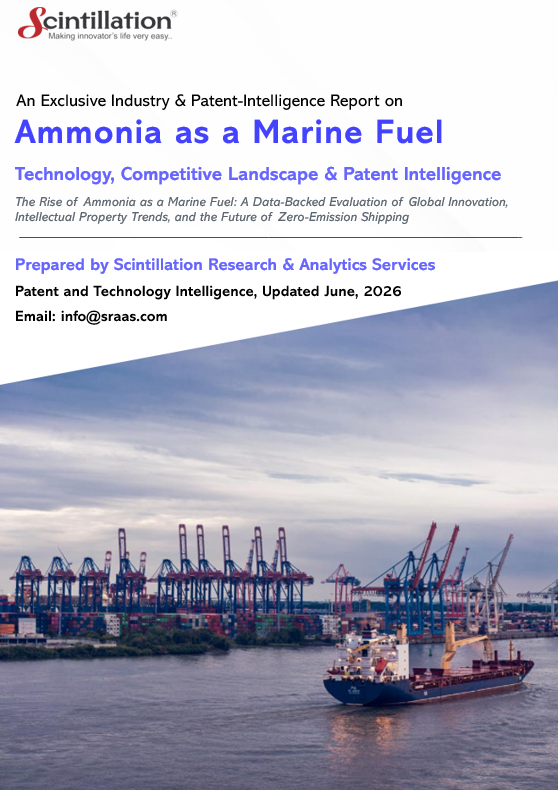
The Rise of Ammonia as a Marine Fuel: A Data-Backed Evaluation of Global Innovation, Intellectual Property Trends, and the Future of Zero-Emission Shipping

A data-grounded look at who is filing, where innovation is concentrated, and why ammonia is emerging as a strategically critical pathway toward zero-carbon marine propulsion.

A comprehensive technology and patent intelligence analysis of Ammonia as a Marine Fuel — examining dual-fuel and mono-fuel ammonia internal combustion engines, ammonia fuel supply and storage systems, onboard cracking and reforming technologies, ammonia-powered fuel cells, NOx/N2O aftertreatment systems, and bunkering infrastructure enabling next-generation zero-emission commercial shipping.

Zero-CarbonSulfur-free combustion fuel
Dual-FuelAmmonia internal combustion
Fuel CellsSOFC & PEM ammonia conversion
PatentLandscape & whitespace analysis

Report details

Ammonia as a Marine Fuel — Technology & Patent Intelligence Report

Publisher Scintillation Research
Technology Ammonia Marine Fuel Systems
Focus area Zero-Emission Marine Propulsion
Key segments Engines, Storage, Fuel Cells, Bunkering
IP coverage 10-part patent landscape
Applications Bulk Carriers, Tankers, Container Ships
Audience IP, R&D, Strategy, Investment
NH3 Zero-carbon marine fuel
0 Sulfur oxide combustion output
IMO Regulatory compliance pathway
IP 10-part patent analysis
Bunkering Port infrastructure readiness
Introduction

When heavy fuel oil can no longer meet the decarbonization demands of global shipping

The global shipping industry is advancing rapidly as demand grows for sustainable marine propulsion systems, zero-emission vessel architectures, decarbonised port infrastructure, and regulatory-compliant fuel supply chains. As international pressure to reduce greenhouse gas emissions continues to intensify, conventional heavy fuel oil-based marine propulsion faces growing challenges related to carbon dioxide output, sulfur oxide emissions, regulatory non-compliance risk, and long-term energy security.

To address these constraints, shipbuilders, engine manufacturers, and energy producers are exploring alternative fuel technologies capable of delivering zero-carbon propulsion, improved environmental performance, and compatibility with evolving international maritime regulations.

One of the most promising approaches is Ammonia as a Marine Fuel, which combines ammonia's zero-carbon and sulfur-free combustion properties with next-generation marine engine and fuel cell architectures. By replacing conventional fossil fuels with ammonia produced from renewable energy sources, ammonia-fueled marine systems have the potential to support large-scale decarbonization of international shipping, long-range zero-emission voyages, and compliance with increasingly stringent IMO and regional greenhouse gas reduction targets.

Key areas of development include dual-fuel and mono-fuel ammonia internal combustion engines, onboard ammonia fuel supply and storage systems, ammonia cracking and reforming technologies, solid oxide and proton exchange membrane fuel cells, nitrogen oxide and nitrous oxide aftertreatment systems, and bunkering infrastructure technologies. Innovation efforts are being driven by shipbuilders, engine manufacturers, classification societies, green ammonia producers, port operators, and research institutions as the industry investigates pathways toward scalable, commercially viable zero-emission marine propulsion for bulk carriers, tankers, container vessels, offshore support ships, and next-generation sustainable shipping fleets.

Report structure

Table of contents

Ten chapters connecting ammonia marine fuel's technical foundations to patent landscape intelligence and commercialization strategy. Click any chapter to expand.

Condensed findings on ammonia marine fuel technology, top patent assignees, filing trends, competitive dynamics, and strategic implications for zero-emission shipping IP
Who Will Benefit from This Report — marine engineers, shipbuilders, IP counsel, maritime regulators, and technology investors tracking zero-emission propulsion technologies
3.1 Challenges in Conventional Marine Fuels and the Transition to Zero-Carbon Propulsion — carbon dioxide output, sulfur oxide emissions, regulatory non-compliance risk, and long-term energy security limitations of heavy fuel oil
Structural Components of Ammonia as a Marine Fuel Technology — dual-fuel and mono-fuel engines, onboard storage tanks, cracking and reforming units, fuel cell stacks, and aftertreatment systems
4.1 Key Features — zero-carbon and sulfur-free combustion, fuel flexibility, compatibility with renewable ammonia production, and scalability across vessel classes
4.2 Problems Ammonia as a Marine Fuel Aims to Solve — greenhouse gas emissions, sulfur oxide pollution, regulatory compliance risk, and fossil-fuel energy security limitations
4.3 Potential Applications — bulk carriers, tankers, container vessels, offshore support ships, and next-generation sustainable shipping fleets
Ammonia marine fuel deployment roadmap, pilot projects and demonstration vessels, bunkering infrastructure build-out, and near-term commercialization opportunities for zero-emission shipping
6.1 Methodology & Scope — patent database coverage, search strategy, classification framework, and analytical approach for ammonia marine fuel IP
6.2 Top Assignees — leading filers across engine manufacturers, shipbuilders, green ammonia producers, and classification societies, with notable assignee profiles
6.3 Filing Activity Over Time — trend analysis identifying R&D acceleration and IP maturity signals across ammonia marine fuel technology domains
6.4 Jurisdiction Coverage — USPTO, CNIPA, KIPO, JPO, EPO, and WIPO distributions across the ammonia marine fuel patent landscape
6.5 Technology Segmentation — patents mapped to combustion engines, fuel storage and supply, cracking and reforming, fuel cells, aftertreatment systems, and bunkering infrastructure
6.6 Foundational Anchor Patents — core IP defining the ammonia marine fuel landscape and their strategic competitive significance
6.7 Representative Publications Across the Field — key academic and industry publications shaping ammonia marine fuel research direction
6.8 Whitespace & Strategic Opportunities — underprotected technology domains and emerging filing opportunities across the ammonia marine fuel IP ecosystem
Stakeholder-specific takeaways for marine engineers, shipbuilders, IP counsel, port operators, and technology investors
Synthesis of ammonia marine fuel's technical trajectory, IP landscape dynamics, and strategic implications for zero-emission shipping commercialization
Publisher profile, research methodology, and service overview — patent analytics, technology scouting, competitive intelligence, and strategic research across maritime decarbonization domains
Full legal disclaimer covering information accuracy, IP ownership, and terms of use for this intelligence report
Inside Ammonia as a Marine Fuel Technology

Structural components & key features

Ammonia marine fuel systems integrate combustion, storage, fuel-cell, and emissions-control technologies purpose-built around ammonia's chemical properties — enabling zero-carbon propulsion across the full range of commercial vessel classes.

Dual-fuel & mono-fuel ammonia engines
Internal combustion engines engineered to run on ammonia alone or in combination with a pilot fuel — adapting combustion chemistry, ignition timing, and materials to ammonia's distinct combustion characteristics.
Ammonia fuel supply & storage systems
Onboard tank, piping, and supply architectures designed to safely store and deliver liquid ammonia at the pressures and temperatures required for marine fuel use.
Onboard ammonia cracking & reforming
Catalytic systems that decompose ammonia into hydrogen and nitrogen onboard the vessel — enabling hydrogen-fed combustion or fuel-cell pathways from a single stored fuel.
Ammonia-powered fuel cells
Solid oxide fuel cell (SOFC) and proton exchange membrane (PEM) fuel cell systems converting ammonia or cracked hydrogen directly into electrical power for propulsion and auxiliary loads.
NOx & N2O aftertreatment systems
Exhaust treatment technologies that capture and reduce nitrogen oxide and nitrous oxide byproducts of ammonia combustion — addressing a key environmental tradeoff of ammonia as a marine fuel.
Bunkering & port infrastructure
Fuel transfer, storage, and safety systems at port enabling efficient and safe ammonia refueling for vessels — a critical enabler for ammonia's commercial viability at scale.
Onboard safety & leak mitigation
Detection, containment, and ventilation systems addressing ammonia's toxicity — engineered to protect crew and vessel integrity in the event of fuel system leaks.
Pilot projects & demonstration vessels
Early commercial and demonstration ammonia-fueled vessels providing real-world performance data that informs engine, storage, and safety system refinement.
Patent landscape preview

Leading ammonia marine fuel patent assignees

The ammonia marine fuel IP landscape reflects engagement across the full maritime decarbonization value chain — engine manufacturers developing combustion and fuel-cell systems, shipbuilders integrating vessel architectures, classification societies establishing safety standards, and green ammonia producers securing supply-chain positions.

Top assignees by filing activity

#1 · Engine
MAN Energy Solutions
Marine ammonia engine development · Germany
#2 · Engine
WinGD
Two-stroke ammonia engine technology · Switzerland
#3 · Shipbuilder
Mitsubishi Shipbuilding
Ammonia-fueled vessel design · Japan
#4 · Shipbuilder
Hyundai Heavy Industries
Ammonia carrier & fuel-ready vessels · Korea
#5 · Classification
DNV
Maritime safety & classification standards · Norway
#6 · Energy
Yara International
Green ammonia production & bunkering · Norway
#7 · Engine
Wärtsilä
Marine power & ammonia engine systems · Finland
#8 · Research
MISC Berhad
Ammonia-fueled tanker demonstration · Malaysia
Challenges addressed

Why conventional marine fuels cannot meet zero-emission shipping demands

Ammonia as a marine fuel directly targets five structural constraints that prevent conventional heavy fuel oil from meeting the emissions, efficiency, and regulatory requirements of next-generation zero-emission shipping.
01
Greenhouse gas emissions
Heavy fuel oil combustion releases substantial carbon dioxide, contributing significantly to the shipping industry's greenhouse gas footprint. Ammonia produced from renewable energy sources contains no carbon, enabling near-zero CO2 combustion when burned in marine engines
Emissions
02
Sulfur oxide pollution
Conventional marine fuels release sulfur oxides that contribute to air pollution and acid rain, driving increasingly strict international sulfur emission limits. Ammonia combustion is inherently sulfur-free, eliminating this pollutant entirely
Sulfur emissions
03
Regulatory non-compliance risk
Tightening IMO and regional greenhouse gas reduction targets put fossil-fuel-dependent vessels at risk of non-compliance and associated commercial penalties. Ammonia-fueled propulsion offers a credible pathway to meet evolving international maritime regulatory requirements
Regulatory compliance
04
Combustion & energy efficiency limitations
Ammonia's combustion properties differ substantially from conventional marine fuels, requiring engine redesign, pilot-fuel co-combustion, or cracking to hydrogen to achieve efficient and stable combustion. Ongoing engine and fuel-cell innovation is closing this performance gap
Energy efficiency
05
Long-term energy security & supply-chain readiness
Fossil-fuel-dependent shipping remains exposed to long-term price and supply volatility, while ammonia bunkering infrastructure and green ammonia production capacity are still scaling globally. Coordinated investment across production, port infrastructure, and vessel technology is addressing this transition gap
Energy security

Download Your Sample Report Now:

    Application areas

    Where ammonia marine fuel creates critical decarbonization impact

    Ammonia's zero-carbon combustion and scalability advantages are most compelling in applications where long-range propulsion, regulatory exposure, and fuel-supply economics push conventional marine fuels beyond their practical and environmental limits.

    Bulk Carriers
    Long-haul dry bulk shipping benefiting from ammonia's energy density and compatibility with extended voyage profiles
    Tankers
    Crude and product tankers — including ammonia carriers themselves — well positioned for early ammonia-fuel retrofit and newbuild adoption
    Container Vessels
    Major container shipping operators pursuing ammonia-fueled fleets to meet corporate and regulatory decarbonization commitments
    Offshore Support Vessels
    Offshore energy support fleets evaluating ammonia fuel cells and combustion systems for reduced operational emissions
    Green Ammonia Production
    Renewable-powered ammonia synthesis facilities scaling supply to meet emerging marine fuel demand
    Port & Bunkering Infrastructure
    Port operators building ammonia storage, transfer, and safety infrastructure to support fleet refueling at scale
    Classification & Maritime Regulation
    Classification societies and regulatory bodies developing safety codes and certification frameworks for ammonia-fueled vessels
    Next-Generation Sustainable Shipping Fleets
    Broader commercial shipping fleets integrating ammonia alongside other zero-emission fuel pathways for long-term decarbonization strategy
    Patent intelligence

    The ammonia marine fuel patent landscape — a 10-part analysis

    The patent landscape chapter delivers data-grounded IP intelligence — from methodology and top-assignee profiling to filing trends, technology segmentation, anchor patents, representative publications, and whitespace identification across the full ammonia marine fuel ecosystem.

    Assignee & filing intelligence
    • Methodology and scope defining the boundaries of ammonia marine fuel patent analysis
    • Top assignees and notable profiles — engine manufacturers, shipbuilders, green ammonia producers, and classification societies shaping the ammonia marine fuel IP landscape
    • Filing activity over time — trend analysis identifying R&D acceleration points and IP maturity signals across ammonia marine fuel technology segments
    • Jurisdiction coverage — USPTO, CNIPA, KIPO, JPO, EPO, and WIPO distributions across the ammonia marine fuel patent corpus
    Technology & strategic analysis
    • Technology segmentation — combustion engines, fuel storage and supply, cracking and reforming, fuel cells, aftertreatment systems, and bunkering infrastructure
    • Foundational anchor patents — core IP defining the ammonia marine fuel landscape and their strategic competitive significance
    • Representative publications — key academic and industry papers shaping ammonia marine fuel research direction and commercialization roadmap
    • Whitespace & strategic opportunities — underprotected technology domains and emerging ammonia marine fuel filing and licensing opportunities
    Who will benefit

    Who should read this report

    Marine & Mechanical Engineers
    Technical teams designing ammonia combustion engines, fuel storage systems, cracking units, and fuel cell architectures for next-generation vessels.
    Shipbuilders & Vessel Designers
    Naval architects and shipbuilders integrating ammonia fuel systems into newbuild and retrofit vessel designs across bulk carriers, tankers, and container ships.
    IP Counsel & Patent Teams
    Attorneys and patent professionals assessing portfolio positioning, whitespace, freedom-to-operate, and filing strategy across ammonia engine, storage, and fuel-cell technologies.
    Maritime Regulators & Classification Societies
    Regulatory and standards bodies developing safety codes, certification pathways, and compliance frameworks for ammonia-fueled commercial shipping.
    Port Operators & Energy Producers
    Port infrastructure planners and green ammonia producers evaluating bunkering investment, supply-chain scaling, and competitive positioning.
    Technology Investors
    Investment professionals tracking the maritime decarbonization ecosystem, the ammonia marine fuel IP landscape, and emerging companies across engines, storage, and bunkering infrastructure.
    Technology & Patent Intelligence · Scintillation Research

    Understand who is building the IP foundation for zero-emission shipping

    Get the complete technology and patent intelligence report on Ammonia as a Marine Fuel — from dual-fuel engines and onboard fuel cells to the patent landscape revealing who is filing, where innovation is concentrated, and why ammonia is emerging as a strategically critical pathway toward zero-emission shipping.

    Scintillation Research · Ammonia as a Marine Fuel · Patent Intelligence Series

    For a quick demo, schedule a meeting now!

    Service Demo Booking
    About

    About Scintillation Research

    Scintillation Research & Analytics Services is a specialized intellectual property and technology intelligence firm delivering patent analytics, technology scouting, competitive intelligence, and strategic research services.

    Through comprehensive patent and technology intelligence reports, we help organizations understand emerging innovations, identify market opportunities, monitor competitors, and make data-driven decisions across rapidly evolving technology domains. Our reports are designed for professionals at the intersection of technology strategy, IP management, and competitive intelligence.

    Shopping Cart (0 items)

    Subscribe to our newsletter

    Sign up to receive latest news, updates, promotions, and special offers delivered directly to your inbox.
    No, thanks
    Select your currency