

A comprehensive dataset of active and granted worldwide patents was built by covering features of Structural Battery Composites for the Automotive Industry. We identified the following categorizations of patents based on the field of invention and the core technology area of patents:
- Manufacturing and Processing Methods
- Energy Storage Mechanism
- Electrolyte
- Performance Metrics
- Binder Material
- Fiber Type
- Load-Bearing Constituents
- Electrochemical Constituents
- Structural Architectures
We identify patent families using combinations of keywords, CPCs, assignees, and citations, with a focus on the newly added features.
After combining all results, we compiled a list of over XXX patent families.
Phase 2
We focused on identifying patents related to the Automotive industry. An analysis of the title, abstract, and claims of each patent was conducted to identify patents with limitations related to applications in Electric Vehicles. Patents related to other industries were removed from our list. However, patents having multiple applications, including automotive, were considered for further analysis.
After removing irrelevant patents, the refined list comprised XXX patent families.
Phase 3
Categorisation of all patent families was performed based on manufacturing methods, mechanisms, and materials. This includes the energy storage mechanism, type of electrolyte, processing methods, performance metrics, binder material, and fiber type, among others.
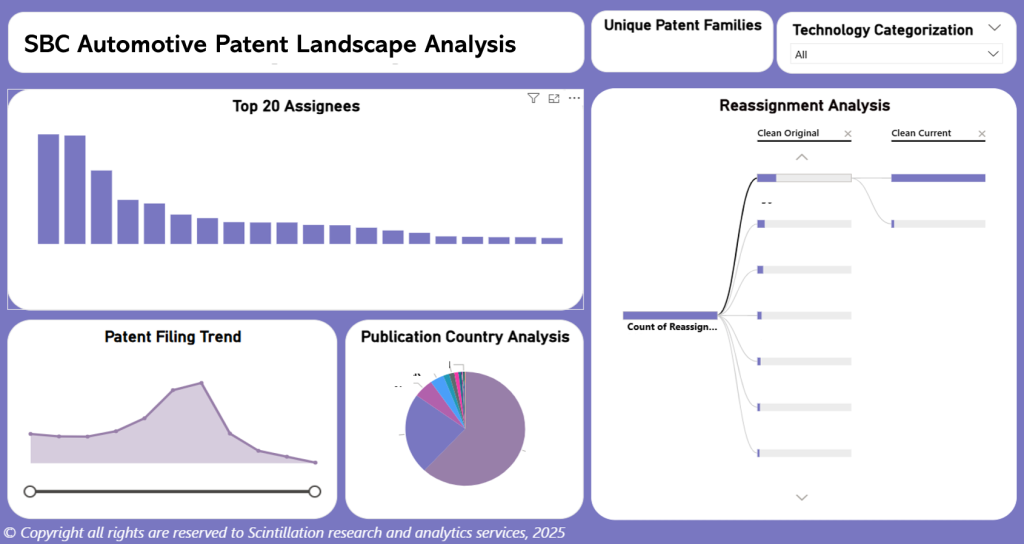
We have prepared a comprehensive interactive dashboard to give a holistic overview of all patents in the SBC Automotive domain.
Although IEEE maintains a database of LoAs submitted by patent holders, these declarations do not fully reflect the actual landscape of a particular technology. Therefore, we recognised the need to create a patent landscape relevant to the Wi-Fi 6 standard. We employed a four-phase approach to conduct this detailed study.
In Phase 1, we focused on building a comprehensive dataset of active, granted worldwide patents covering the newly added features of the Wi-Fi 6 standard. Based on several publicly available reports and research papers, we identified the following features as new additions in 802.11ax compared to the previous standard, 802.11ac:
- Orthogonal Frequency Division Multiple Access (OFDMA)
- Multi-User Multiple Input Multiple Output (MU-MIMO)
- Target Wake Time (TWT)
- Beamforming
- Basic Service Set (BSS) Colouring
- 1024 QAM
- 160 MHz
- Spatial Streams
We followed a four-step approach during Phase 1 to create a comprehensive patent dataset.
Step 1: Extract all patents listed under LoAs declared to 802.11ax or 802.11 2020.
Step 2: Extract patents listed in the list published by Sisvel as of March 21, 2025.
Step 3:
Step 4: Identify patent families using combinations of keywords, CPCs, assignees, and citations, with a focus on the newly added features. We restricted our key strings to a priority date of 'on or before Feb 2021' to match the approval date of 802.11ax.
After combining all results from Steps 1-3, we compiled a list of over 3,000 patent families.
We recognise the terminology similarities between 5G and Wi-Fi 6 technologies; therefore, we expected a substantial number of telecom patents to be captured in Step 3.
In Phase 2, we focused on identifying patents unrelated to the Wi-Fi 6 technology domain. We analysed the title, abstract, and claims to identify patents with limitations related to telecom terminologies or concepts, such as LTE, UMTS, PDCCH, PDSCH, and similar. Such patents were removed from our list. However, patents written with broad terminology or concepts applicable to both telecom and Wi-Fi 6 technologies were considered for further analysis.
Additionally, we identified several patent families related to coordinated beamforming, 320 MHz, EHT, MLO, and similar concepts, which are also associated with the WiFi-7 standard, and were excluded from the list.
After removing irrelevant patents, the refined list comprised 2,011 patent families, including over 35 patent families declared to ETSI under various telecom specifications.
In Phase 3, we categorised all 2,011 patents based on newly added features, including Beamforming, MU-MIMO, spatial streams, OFDMA, and 160 MHz, among others.
In Phase 4, we performed a detailed analysis of each patent family in the list without utilising any AI algorithm to determine the essentiality of the claims with respect to 802.11-2020 or 802.11ax. Our team reviewed each patent family in detail and assessed its essentiality, providing rationale and excerpts from the relevant standards to support their findings. When our team identifies evidence in the standard for each claim limitation, we mark the family as essential and proceed to the next one. In a situation, if our team found a particular independent claim to be non-essential to the standard due to certain limitations, we reviewed the following independent claim for analysis purposes. Further, if no independent claim of that patent was found to be essential, we reviewed the other granted family member for essentiality purposes. We have marked a particular patent family as non-essential only after reviewing all granted family members.
Please note that our team has not conducted a prior art or invalidity search to determine the validity of the essential patents.
We have done an extensive study on Wi-Fi 6 technology and prepared a comprehensive report. Our team has carried out a manual assessment on each of 2000+ patent families to determine the essentiality of patent claims with 802.11 2020 or 802.11 ax standard. The following insights were derived from the report.
- 1000+ active granted patent families are essential to the WiFi-6 standard.
- Huawei has the most significant number of essential patents.
- 85% of the essential patents have at least one US family member.
- 54 unique assignees are having at least one essential patent.
- 11 patent families were found to be essential to WiFi-6 that are declared to ETSI as well.
We have prepared a comprehensive interactive dashboard to give a holistic overview of all essential patents in the Wi-Fi 6 technology domain.

Although IEEE maintains a database of LoAs submitted by patent holders, these declarations do not fully reflect the actual landscape of a particular technology. Therefore, we recognised the need to create a patent landscape relevant to the Wi-Fi 6 standard. We employed a four-phase approach to conduct this detailed study.
In Phase 1, we focused on building a comprehensive dataset of active, granted worldwide patents covering the newly added features of the Wi-Fi 6 standard. Based on several publicly available reports and research papers, we identified the following features as new additions in 802.11ax compared to the previous standard, 802.11ac:
- Orthogonal Frequency Division Multiple Access (OFDMA)
- Multi-User Multiple Input Multiple Output (MU-MIMO)
- Target Wake Time (TWT)
- Beamforming
- Basic Service Set (BSS) Colouring
- 1024 QAM
- 160 MHz
- Spatial Streams
We followed a three-step approach during Phase 1 to create a comprehensive patent dataset.
Step 1: Extract all patents listed under LoAs declared to 802.11ax or 802.11 2020.
Step 2: Extract patents listed in the list published by Sisvel as of March 21, 2025.
Step 3: Identify patent families using combinations of keywords, CPCs, assignees, and citations, with a focus on the newly added features. We restricted our key strings to a priority date of 'on or before Feb 2021' to match the approval date of 802.11ax.
After combining all results from Steps 1-3, we compiled a list of over 3,000 patent families.
We recognise the terminology similarities between 5G and Wi-Fi 6 technologies; therefore, we expected a substantial number of telecom patents to be captured in Step 3.
In Phase 2, we focused on identifying patents unrelated to the Wi-Fi 6 technology domain. We analysed the title, abstract, and claims to identify patents with limitations related to telecom terminologies or concepts, such as LTE, UMTS, PDCCH, PDSCH, and similar. Such patents were removed from our list. However, patents written with broad terminology or concepts applicable to both telecom and Wi-Fi 6 technologies were considered for further analysis.
Additionally, we identified several patent families related to coordinated beamforming, 320 MHz, EHT, MLO, and similar concepts, which are also associated with the WiFi-7 standard, and were excluded from the list.
After removing irrelevant patents, the refined list comprised 2,011 patent families, including over 35 patent families declared to ETSI under various telecom specifications.
In Phase 3, we categorised all 2,011 patents based on newly added features, including Beamforming, MU-MIMO, spatial streams, OFDMA, and 160 MHz, among others.
In Phase 4, we performed a detailed analysis of each patent family in the list without utilising any AI algorithm to determine the essentiality of the claims with respect to 802.11-2020 or 802.11ax. Our team reviewed each patent family in detail and assessed its essentiality, providing rationale and excerpts from the relevant standards to support their findings. When our team identifies evidence in the standard for each claim limitation, we mark the family as essential and proceed to the next one. In a situation, if our team found a particular independent claim to be non-essential to the standard due to certain limitations, we reviewed the following independent claim for analysis purposes. Further, if no independent claim of that patent was found to be essential, we reviewed the other granted family member for essentiality purposes. We have marked a particular patent family as non-essential only after reviewing all granted family members.
Please note that our team has not conducted a prior art or invalidity search to determine the validity of the essential patents.
We have created an interactive dashboard for Wi-Fi 6 patent landscape
