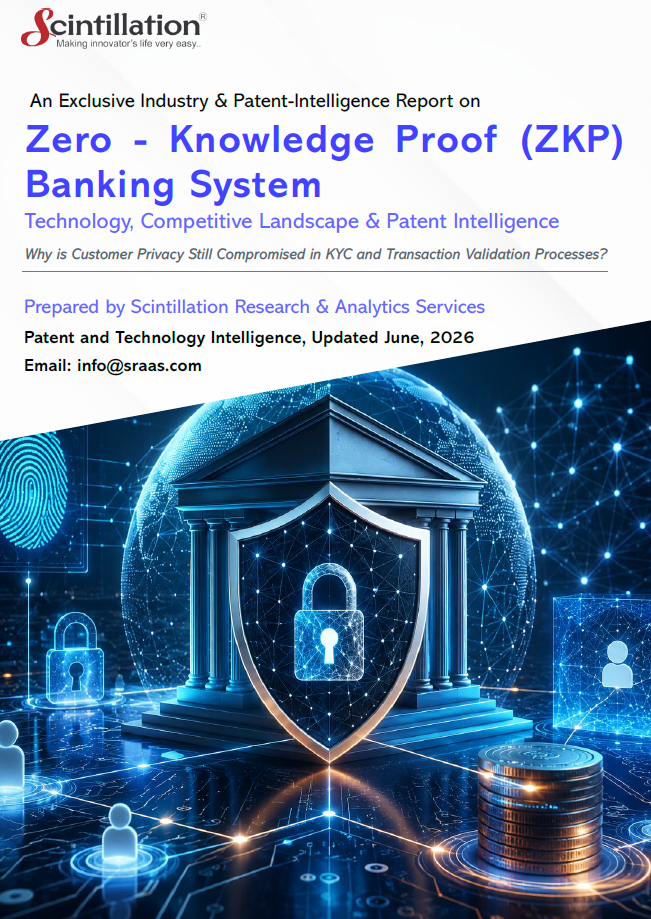
Zero Knowledge Proof (ZKP) Banking System

  • Home
  • Zero Knowledge Proof (ZKP) Banking System
Zero-Knowledge Proof (ZKP) Banking System: Why Is Customer Privacy Still Compromised in KYC and Transaction Validation? | Scintillation Research
Industry Intelligence Report  ·  Financial Privacy & Compliance Series

Zero-Knowledge Proof (ZKP) Banking System: Why Is Customer Privacy Still Compromised in KYC and Transaction Validation Processes?

A look at how zero-knowledge proof technologies can be implemented in traditional banking environments to minimise data exposure while preserving necessary verification and auditing capability.

A comprehensive technology analysis of Zero-Knowledge Proof Banking Systems — examining how ZK technologies can be applied to account opening, deposit and withdrawal transactions, fund transfers, and regulatory compliance, enabling a next-generation banking model where customer data exposure is minimised without compromising the verification and auditing processes banks require.

Privacy-PreservingVerification without exposure
KYC ReimaginedIdentity proof without disclosure
Compliant by DesignAudit-ready without surveillance
Beyond BlockchainApplicable to traditional banking rails

Report details

Zero-Knowledge Proof (ZKP) Banking System — Technology & Strategy Intelligence Report

Publisher Scintillation Research
Technology Zero-Knowledge Proof Banking
Focus area Privacy-Preserving Financial Compliance
Key use cases Account Opening, Transfers, Audits
Infrastructure scope Blockchain & Traditional Banking Rails
Applications KYC, AML, Reserves, Transaction Validation
Audience Banking, Compliance, Strategy, Investment
ZKP Zero-knowledge proof banking
1.4B Adults remain unbanked globally
0 Sensitive data disclosed to verify
KYC Reimagined identity verification
AML Compliance without surveillance
Introduction

When proving compliance no longer requires exposing everything

Imagine walking into a bank and being asked for your entire financial history just to prove you have enough funds for a simple transaction. Now imagine if you could verify your balance without ever showing your actual bank statements. Wouldn't you feel safer knowing your private financial data isn't being stored or shared? That's exactly what Zero-Knowledge Proofs (ZKPs) make possible.

For decades, financial regulations have required extreme transparency, forcing banks to collect and store vast amounts of personally identifiable information in the name of compliance. The result has been massive data breaches, with hackers stealing millions of financial records every year. Financial exclusion has worsened, as 1.4 billion adults remain unbanked due to rigid KYC requirements. Regulatory overreach has also expanded, giving governments and institutions unprecedented access to financial data.

The financial system has long operated under the assumption that compliance requires exposure. But ZKPs rewrite the rulebook, proving compliance without revealing sensitive data. In banking, ZKPs allow customers to verify their identity without sharing personal details. Banks can prove AML compliance without revealing transaction histories. Financial institutions can confirm liquidity reserves without exposing balance sheets. It's compliance without surveillance, security without intrusion, and privacy without compromise.

Think of ZKPs as a sealed envelope with a hidden answer inside. A verifier can shake the envelope, feel its shape, and confirm that the answer is correct — without ever opening it.

Report structure

Table of contents

Ten chapters connecting ZKP banking's technical foundations to practical use cases, comparative analysis, and forward-looking strategy. Click any chapter to expand.

Condensed findings on ZKP banking technology, privacy-preserving compliance models, and strategic implications for financial institutions
Who Will Benefit from This Report — banking technology leaders, compliance officers, privacy engineers, regulators, and financial strategists evaluating privacy-preserving verification
3.1 Challenges in the Conventional Banking System — excessive data collection, breach exposure, financial exclusion from rigid KYC, and regulatory overreach into customer privacy
Structural Components of Zero-Knowledge Proof (ZKP) Banking System — prover and verifier roles, cryptographic commitment schemes, proof generation and verification layers, and integration points with banking infrastructure
4.1 Key Features — proof of correctness without data disclosure, non-interactive verification, compatibility with existing compliance frameworks, and applicability beyond blockchain
4.2 Problems Zero Knowledge Proof (ZKP) Banking System Aims to Solve — data over-collection, breach risk, financial exclusion, and surveillance-heavy compliance models
4.3 Potential Applications — identity verification, AML compliance, liquidity and reserve proofs, and privacy-preserving transaction validation
Traditional Banking System vs Zero Knowledge Proof (ZKP) Banking System — comparative analysis of data exposure, verification approach, and compliance methodology
Adoption roadmap, integration pathways with legacy banking infrastructure, regulatory engagement strategies, and near-term deployment opportunities for ZKP banking systems
6.1 Methodology & Scope
6.2 Assignee Picture & Notable Assignee Profiles
6.3 Filing Activity Over Time
6.4 Jurisdiction Coverage
6.5 Technology Segmentation
6.6 Foundational Anchor Patents
6.7 Whitespace & Strategic Opportunities
Stakeholder-specific takeaways for banking technology leaders, compliance officers, privacy engineers, and regulators
Synthesis of ZKP banking's potential to reshape compliance, privacy, and trust in financial systems
Publisher profile, research methodology, and service overview — technology scouting, competitive intelligence, and strategic research across financial privacy domains
Full legal disclaimer covering information accuracy and terms of use for this intelligence report
Inside Zero-Knowledge Proof Banking System

Structural components & key features

A ZKP banking system layers cryptographic proof generation and verification onto existing or blockchain-based banking infrastructure — allowing a customer or institution to prove a statement is true without revealing the underlying data that makes it true.

Prover & verifier roles
The customer or institution acting as "prover" generates a cryptographic proof of a claim, while the bank or regulator acts as "verifier," confirming the claim's validity without seeing the underlying data.
Cryptographic commitment schemes
Mathematical constructs that allow a party to commit to a value while keeping it hidden, with the ability to later prove properties about that value without revealing it.
Proof generation engines
Computational systems that construct succinct cryptographic proofs (such as zk-SNARKs or zk-STARKs) attesting to the truth of a statement about private financial data.
Verification layers
Fast, lightweight verification processes that allow a bank or regulator to confirm a proof's validity in a fraction of the time required to generate it, without re-examining the original data.
Integration with banking infrastructure
Architectural patterns enabling ZKP verification to plug into both blockchain-based settlement systems and traditional, centralized core banking platforms.
Selective disclosure controls
Mechanisms allowing customers to choose precisely which attributes are proven (e.g., "balance exceeds threshold") without revealing the full underlying account details.
Compliance-mapping logic
Rules engines that translate regulatory requirements — such as KYC and AML thresholds — into verifiable statements that can be proven via ZKP without exposing the raw data behind them.
Audit-ready proof trails
Verifiable records of completed proofs that regulators and auditors can review to confirm compliance activity occurred, without requiring access to the sensitive data itself.
Challenges addressed

Why the conventional banking system cannot meet today's privacy expectations

ZKP banking directly targets the structural assumption that compliance requires exposure — addressing the data-collection and surveillance burdens built into conventional KYC, AML, and transaction-validation processes.

01
Excessive personal data collection
Conventional KYC processes require customers to disclose extensive personal and financial information simply to open an account or complete routine transactions, far beyond what is strictly necessary to verify the relevant fact. ZKPs allow specific claims to be proven without disclosing the underlying data
Data over-collection
02
Breach exposure from centralized data stores
Storing vast amounts of personally identifiable financial information creates concentrated, high-value targets for hackers, and breaches have resulted in millions of stolen financial records. Reducing the volume of stored sensitive data through ZKP verification reduces this exposure
Breach risk
03
Financial exclusion from rigid KYC requirements
Strict documentation and identity-verification requirements exclude an estimated 1.4 billion adults globally from formal banking access. Flexible, privacy-preserving proof mechanisms could lower barriers to verified access without weakening underlying compliance standards
Financial exclusion
04
Regulatory overreach into financial privacy
Compliance frameworks have expanded data access for governments and institutions well beyond the minimum needed for legitimate oversight, raising surveillance concerns. ZKP-based compliance allows institutions to demonstrably satisfy regulatory requirements without broad data access
Regulatory overreach
05
Transaction validation requiring full disclosure
Verifying that a customer has sufficient funds or meets a transaction threshold conventionally requires revealing account balances or transaction histories in full. ZKPs make it possible to confirm such conditions are met without exposing the actual financial details
Transaction validation
Banking processes re-examined through ZK

From conventional disclosure to zero-knowledge verification

Core banking use cases — account opening, deposits and withdrawals, transfers, and audits and regulation — can each be reimagined through a zero-knowledge approach, becoming more secure and privacy-focused without sacrificing the verification banks require.

Conventional approach
Account opening
Customer submits full identity documents, address proof, and financial history, all retained by the bank indefinitely.
ZK-based approach
Account opening
Customer proves identity attributes (age, residency, sanctions-list status) via cryptographic proof, without the bank storing the underlying documents.
Conventional approach
Deposits & withdrawals
Full balance and transaction-history visibility is required internally to validate sufficient funds for each transaction.
ZK-based approach
Deposits & withdrawals
A proof confirms sufficient balance exists for the transaction without revealing the exact balance or broader transaction history.
Conventional approach
Fund transfers
Sender and receiver financial details are exposed across intermediary systems to validate and settle the transfer.
ZK-based approach
Fund transfers
Transfer validity, including AML screening, is proven cryptographically while minimizing the financial detail exposed to intermediaries.
Conventional approach
Audits & regulation
Regulators and auditors require broad access to raw transaction and account data to confirm compliance.
ZK-based approach
Audits & regulation
Banks generate verifiable compliance proofs — for AML, reserve requirements, and reporting thresholds — that regulators can confirm without full data access.
Traditional vs ZKP banking

Traditional banking system vs zero-knowledge proof (ZKP) banking system

A side-by-side view of how a ZKP-based approach differs from the data-disclosure model that underpins most banking verification today.

Dimension Traditional Banking System Zero-Knowledge Proof (ZKP) Banking System
Data exposure Full identity, balance, and transaction data shared and stored Only the validity of a specific claim is proven; underlying data stays private
Identity verification Document submission and manual or automated review of full records Cryptographic proof of identity attributes without document disclosure
Compliance model Compliance achieved through broad data access and retention Compliance achieved through verifiable proofs, minimizing data retention
Breach exposure Centralized data stores represent high-value attack targets Reduced sensitive data footprint lowers the impact of potential breaches
Financial inclusion Rigid documentation requirements can exclude underserved populations Flexible attribute-based proofs may lower barriers to verified access
Infrastructure compatibility Built primarily for centralized core banking systems Applicable to both blockchain-based and traditional banking infrastructure

Download Your Sample Report Now:

    Application areas

    Where ZKP banking creates critical privacy impact

    ZKP's privacy-preserving verification is most valuable in applications where conventional disclosure-based processes create unnecessary data exposure, breach risk, or barriers to access.

    Identity Verification & KYC
    Proving identity attributes such as age, residency, or sanctions-list status without disclosing full documentation
    AML Compliance
    Demonstrating anti-money-laundering screening compliance without exposing complete transaction histories
    Reserve & Liquidity Proofs
    Financial institutions confirming sufficient reserves or liquidity without revealing full balance sheets
    Transaction Validation
    Confirming sufficient funds and transaction legitimacy without exposing account balances or histories
    Cross-Border Payments
    Validating compliance across jurisdictions without exposing sensitive financial data to multiple intermediaries
    Regulatory Reporting & Audits
    Providing regulators with verifiable compliance proofs without granting broad access to raw customer data
    Financial Inclusion Initiatives
    Lowering documentation barriers for underserved populations while maintaining verifiable compliance standards
    Blockchain & Digital Asset Banking
    Privacy-preserving verification for decentralized finance platforms and digital asset custody services
    Who will benefit

    Who should read this report

    Banking Technology Leaders
    Technology leaders evaluating ZKP integration pathways for core banking infrastructure, identity verification, and transaction processing systems.
    Compliance Officers & Risk Teams
    Compliance professionals assessing how ZKP-based verification can satisfy KYC and AML obligations while reducing data retention exposure.
    Privacy & Cryptography Engineers
    Technical teams designing proof-generation systems, commitment schemes, and verification layers for privacy-preserving banking applications.
    Regulators & Policy Makers
    Regulatory bodies evaluating how verifiable proof mechanisms could satisfy oversight requirements while reducing surveillance burden on customers.
    Financial Inclusion Strategists
    Organizations exploring how flexible, privacy-preserving verification could expand access to banking for underserved populations.
    Technology Investors
    Investment professionals tracking the privacy-preserving finance ecosystem and emerging companies building ZKP infrastructure for banking applications.
    Technology & Strategy Intelligence · Scintillation Research

    Understand how zero-knowledge proofs can redefine banking privacy

    Get the complete technology and strategy report on Zero-Knowledge Proof Banking Systems — from account opening and transfers to AML compliance and audits, examining how ZK technologies can deliver compliance without surveillance, security without intrusion, and privacy without compromise.

    Scintillation Research · Zero-Knowledge Proof Banking System · Intelligence Series

    For a quick demo, schedule a meeting now!

    Service Demo Booking
    About

    About Scintillation Research

    Scintillation Research & Analytics Services is a specialized intellectual property and technology intelligence firm delivering patent analytics, technology scouting, competitive intelligence, and strategic research services.

    Through comprehensive patent and technology intelligence reports, we help organizations understand emerging innovations, identify market opportunities, monitor competitors, and make data-driven decisions across rapidly evolving technology domains. Our reports are designed for professionals at the intersection of technology strategy, IP management, and competitive intelligence.

    Shopping Cart (0 items)

    Subscribe to our newsletter

    Sign up to receive latest news, updates, promotions, and special offers delivered directly to your inbox.
    No, thanks
    Select your currency